Wading Techniques for Alberta Trout Rivers
Wading Alberta's trout rivers is an experience that calls to the soul – the rush of clear, cold water, the breathtaking scenery, and the promise of a magnificent fish. But let's be honest, those beautiful rivers can also be incredibly intimidating and downright dangerous if you're not prepared. Whether it's the powerful currents of the Bow River or the treacherous, algae-covered rocks of a mountain stream, navigating these waters safely and effectively is key to a successful and enjoyable day. This comprehensive guide will equip you with the knowledge and techniques you need to wade Alberta's trout rivers with confidence, ensuring both your safety and a better fishing experience.
Understanding the Unique Dynamics of Alberta's Trout Rivers
Alberta's vast and varied landscape offers a diverse range of trout fishing opportunities, from the roaring mountain rivers to the gentler prairie streams. Each presents its own set of challenges and demands specific wading considerations. It's not just about getting from point A to point B; it's about understanding the nuances of the water beneath your feet.
The Diverse Footing of Mountain and Prairie Streams
When you think of Alberta trout fishing, often the first image that comes to mind is a majestic mountain river. Rivers like the Bow River near Calgary, the Crowsnest River in the southwest, or the Highwood River upstream in Kananaskis Country are iconic for their incredible trout populations. These rivers typically feature cold, crystal-clear water, and their bottoms are predominantly composed of smooth, often algae-covered rocks, gravel, and large boulders. The currents can be surprisingly powerful, even in what appear to be shallower sections, and the depth can change dramatically within just a few steps. It's this combination of fast water and slippery, uneven footing that makes mountain stream wading a constant test of balance and awareness. A single misstep on a mossy rock can send you tumbling.
Contrast this with some of the prairie-influenced streams, or the lower stretches of rivers that originate in the mountains but flow out into the flatter lands, such as sections of the Red Deer River or the Oldman River. Here, the water might be warmer and often has a greater silt or sand content, leading to muddier or softer bottoms. While you might not contend with the same degree of extremely fast, boulder-strewn rapids, these rivers can still hide treacherous deep holes, soft mud that can suck at your boots, or submerged debris like branches and logs. The visibility might also be lower, making it harder to read the bottom. The variability even within a single river system, from its headwaters to its lower reaches, underscores why a flexible and informed approach to wading is absolutely crucial for any angler exploring Alberta.
This continuous variation in riverbed composition and current dynamics means that a "one size fits all" approach to wading simply won't cut it. You might start your day on the upper Bow with clean, predictable gravel, then move downstream to a section with larger, slicker rocks. Or you might find yourself switching from a powerful run to a slow, silty back eddy. Each change requires a mental adjustment and often a slight modification in your wading technique. Recognizing these shifts and adapting your approach is the mark of an experienced and safe wader, allowing you to focus more on the fishing and less on fighting the river.
Reading the Current's Language
The current isn't just water moving downstream; it's a dynamic force with its own language, and learning to interpret it is fundamental to safe and effective wading. Current speed and water depth are intrinsically linked – generally, faster water tends to be shallower, but there are always exceptions, especially around bottlenecks or sudden drops. The river bottom also plays a huge role; a smooth rock bottom will accelerate water flow compared to a gravelly, uneven bottom that creates more friction. Understanding these relationships allows you to predict where the current will be strongest and where it will be gentler, helping you choose the safest path.
Look for visual cues on the surface of the water. Riffles, which are typically shallow, choppy sections, usually indicate faster, shallower water over an uneven bottom. Runs are deeper, smoother-flowing sections that often hold fish but can also be deceptively powerful to wade. Pools, the deepest and slowest sections, might seem easy to wade, but they often have sudden, steep drop-offs from the bank or shallower edges, presenting a "stair-step" hazard. Seams, where fast and slow currents meet, are prime fishing spots but can create turbulent, unstable wading conditions as the current pulls at your legs from different directions. Slack water, found in eddies behind obstructions or close to the bank, is usually the easiest to wade but might require navigating around deeper, slower water to reach.
Spotting hazards isn't just about the obvious, like a raging whitewater section. It's about recognizing subtle dangers. Darker patches of water often indicate deeper sections, which can be fine if the current is slow, but perilous if it's fast. Submerged logs or boulders, even if not visible, can create unexpected current eddies or present a tripping hazard. Areas of calm water might seem inviting, but they could also be covering very deep holes or soft, mucky bottoms. Before you even step into the water, take a moment to scan the river, visualizing your route and identifying potential safe havens or points of no return. Remember that the water you can't see is the most dangerous, making every step a calculated decision. Learning to read the water's language is an ongoing process, but one that significantly enhances both your safety and your success on Alberta's trout rivers. For more general river fishing advice, you might find insight in our guide on How to fish a run and pool trout river.
Your Essential Wading Kit: More Than Just Waders
While your skill and judgment are paramount, having the right gear is non-negotiable for wading safely and comfortably in Alberta's diverse trout rivers. Investing in quality equipment isn't just about comfort; it's a direct investment in your safety and the longevity of your fishing adventures.
Choosing the Right Waders and Boots for Alberta's Conditions
Your waders are your first line of defense against the cold, wet reality of river wading. For Alberta's varied climate and water temperatures, breathable chest waders are the industry standard. Made from advanced materials like Gore-Tex or proprietary blends, these waders offer excellent waterproofness while allowing perspiration to escape, keeping you comfortable throughout the day. Chest waders provide superior protection in deeper water compared to waist-high models, a crucial advantage when navigating the unpredictable depths of rivers like the Bow. When choosing, look for durable, reinforced knee and seat areas, as these are high-wear points. Layering appropriately underneath is also key; light fleece or technical base layers will provide insulation without bulk, allowing your waders to breathe effectively.
Perhaps even more critical than the waders themselves are your wading boots. These are your traction, your stability, and your connection to the riverbed. When it comes to sole types, you typically have three main options. Felt soles offer exceptional grip on slick, mossy rocks, almost like Velcro, but they can be problematic for transporting invasive species between waterbodies if not thoroughly cleaned. Rubber soles are more durable, generally easier to clean, and offer decent grip on dry land or less-slick substrates, but they can be dangerously slippery on wet, algae-covered rocks. The best all-around option for Alberta's mixed terrain is often a studded rubber sole, which combines the durability of rubber with carbide or aluminum studs that bite into slippery surfaces. Many anglers find a combination of rubber soles with removable or permanent studs provides the most confidence. Always prioritize strong ankle support in your boots; scrambling over uneven terrain and bracing against currents demands it. You can find a wide range of reliable options, including various sole types and durable brands, on platforms like Amazon. For a deeper dive into specific models and recommendations, check out our guides on Best Waders for Alberta Trout Rivers and Best Wading Boots for Rocky Rivers.
A proper fit for both waders and boots cannot be overstated. Waders should be snug enough to prevent excess material from flapping in the current but loose enough to allow full range of motion and comfortable layering. Boots should fit securely over your wader booties, preventing heel slip, but not so tight that they pinch or restrict circulation, especially when worn with thick wading socks. Try them on with the same layers you'd wear while fishing to ensure the best fit. Remember, uncomfortable gear is distracting gear, and distractions can lead to mistakes in the river.
The Unsung Hero: Your Wading Staff
If waders and boots are your foundation, a wading staff is your critical third (and sometimes fourth) point of contact with the riverbed. It's not an optional accessory; it's an indispensable safety tool, particularly on Alberta's fast and often treacherous trout rivers. Its primary function is to provide an extra point of stability, acting like a cane or walking stick. This dramatically improves your balance, especially when bracing against strong currents or navigating uneven ground. Beyond stability, a wading staff allows you to probe the riverbed ahead of you. You can test the depth, feel for slippery rocks, identify sudden drop-offs, or check for unstable footing before you commit your weight to a step. This probing capability is a lifesaver, preventing unexpected tumbles and giving you crucial information about the unseen river bottom.
Wading staffs come in various designs. Folding staffs collapse into compact sections, making them easy to carry when not in use, often tucked into a belt or wader strap. Telescopic staffs offer adjustable length and are also quite portable. Fixed-length staffs, while less compact, are generally the most robust and offer the most solid feel. Materials typically range from aluminum to lighter, stiffer carbon fiber. While a lighter staff is nice to carry, ensure it's strong enough to support your full weight if you stumble. The handle should be comfortable and provide a secure grip, even when wet.
The true value of a wading staff lies in its consistent use. Don't just carry it as a decorative accessory; actively integrate it into your wading technique. Before each step, especially in unknown or challenging water, plant the staff firmly ahead of you, test the stability and depth, and then move your foot. Use it to brace yourself as you lean into the current. When crossing fast water, the staff can be planted upstream, creating a stable anchor point against which to pivot. It’s a tool that takes some getting used to, but once you incorporate it, you'll feel a significant increase in confidence and security on the river. For detailed options and reviews, check out our guide on the Best Wading Staff for Fast Current.
Safety and Practical Accessories
Beyond waders, boots, and a staff, there are several other critical items that contribute to a safe and enjoyable day on Alberta's trout rivers. First and foremost, consider a personal flotation device (PFD) or inflatable vest, especially when fishing in high water conditions, strong currents, or particularly cold water like the early season on the Bow River. Even if you're a strong swimmer, the combination of cold water, heavy waders, and fast currents can quickly overwhelm. An inflatable PFD, which often resembles a small fishing vest, is discreet and only inflates when needed, offering peace of mind without hindering casting or movement.
Polarized sunglasses are another non-negotiable item. They cut through the glare on the water's surface, allowing you to see submerged rocks, potential hazards, and crucially, fish. They're a safety tool as much as a fishing aid, protecting your eyes from stray hooks and UV rays. A wide-brimmed hat or cap also offers sun protection and improves visibility by shading your eyes.
Other practical accessories include a sturdy dry bag or waterproof backpack to keep your phone, keys, wallet, and any electronics safe and dry. A sharp, easily accessible knife is important for cutting tangled line or in an emergency. A whistle can be a simple but effective signaling device if you get into trouble. A small, basic first-aid kit, containing essentials like bandages, antiseptic wipes, and pain relievers, is always a good idea, especially when exploring more remote stretches. Consider attaching a retractable lanyard to your wading staff or other frequently used tools to prevent losing them in the current. You can find many of these essential safety and practical items on Amazon, ensuring you're fully equipped before hitting the water. Always remember to carry your Printing or Carrying a Digital Fishing License in Alberta with you.
Fundamental Wading Techniques for Stability and Progress
Stepping into a fast-moving river requires more than just walking; it demands a mindful, deliberate approach. Mastering fundamental wading techniques will not only keep you upright but also make your time on the water more efficient and enjoyable.
The "Shuffle" and "Tripod" Walking Methods
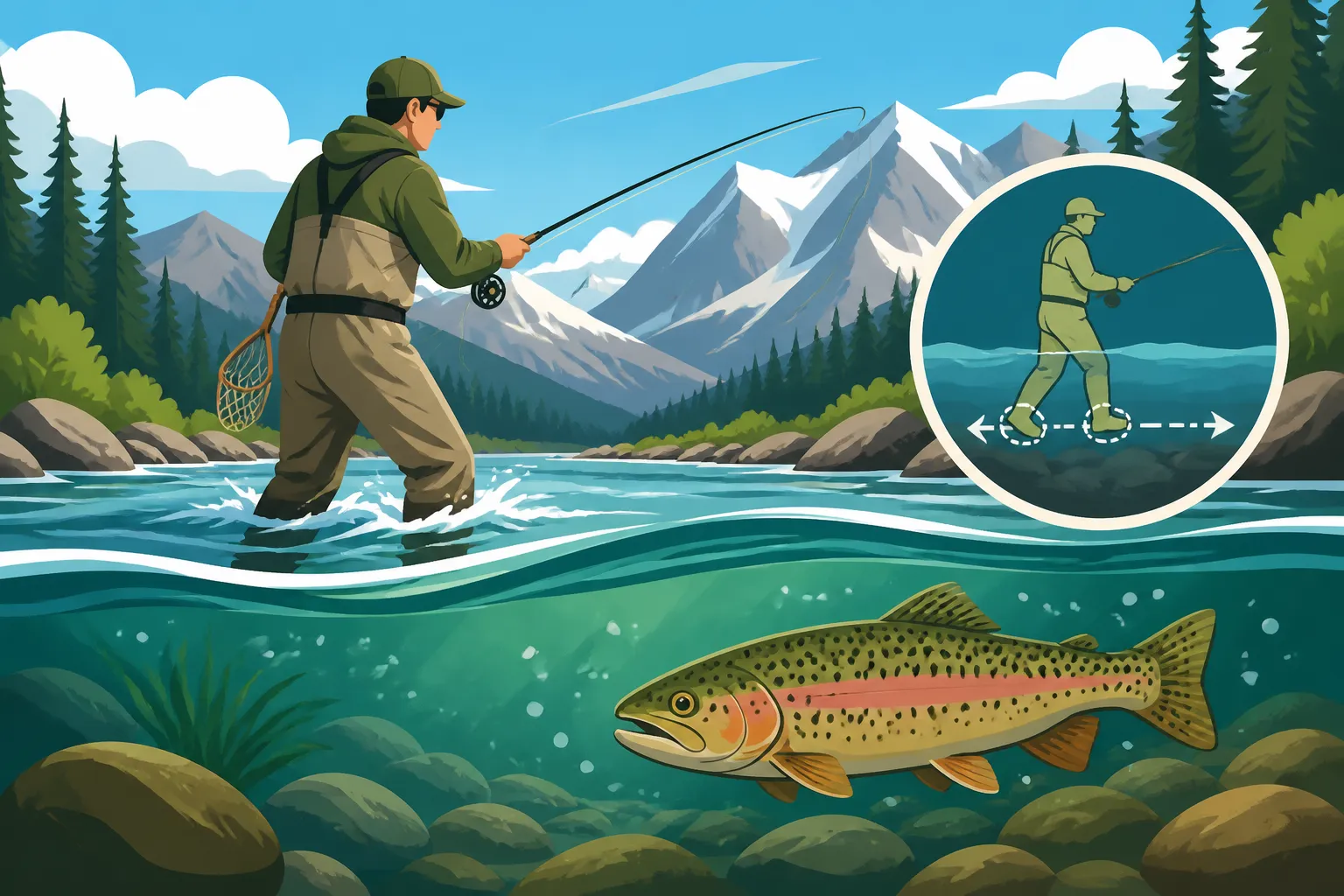
When navigating the unpredictable bottom of an Alberta trout river, your default mode of movement should be either the "shuffle" or the "tripod" method, depending on the conditions. The shuffle involves taking very short, deliberate steps, almost sliding your feet along the bottom rather than lifting them high. This technique keeps your feet in constant contact with the riverbed, allowing you to feel for obstructions, slippery spots, or sudden changes in depth before committing your full weight. By keeping your feet low, you also maintain a lower center of gravity, making you more stable against the current's push. The shuffle is particularly effective in unfamiliar water, areas with many small, loose rocks, or sections where the current is moderate but the footing is uncertain. It's a slow and steady approach, but it minimizes the risk of tripping or losing balance.
The tripod method incorporates your wading staff as a crucial third point of contact, creating a stable triangle of support. Imagine your two feet and your wading staff as the three points of this tripod. The sequence typically goes: plant your wading staff firmly, then move one foot, then the other foot, always ensuring that at least two points (one foot and the staff, or both feet) are securely planted before moving the third. This method provides superior stability, especially in stronger currents or when probing ahead into deeper or more complex water. For instance, when traversing a particularly swift run on the Crowsnest River, you might plant your staff upstream, lean into it, then carefully move your upstream foot, followed by your downstream foot, maintaining that consistent three-point contact. This method allows you to test the ground ahead, identify hazards, and brace yourself against the current's pressure before fully committing your weight.
Knowing when to use each method comes with practice. In general, use the shuffle for shallower, more consistent bottom areas where current isn't overwhelming, and for feeling out the immediate terrain. Reserve the tripod method for deeper, faster, or more challenging crossings where maximum stability and proactive probing are essential. Regardless of the method, the golden rule remains: never rush. Slow, deliberate movements are key. A hasty step in the river can quickly turn a peaceful fishing trip into a dangerous situation.
Strategic River Crossings
Crossing a river, even a seemingly narrow one, can be one of the riskiest parts of wading. It's not just about reaching the other side; it's about doing so safely and efficiently, without expending unnecessary energy or creating a dangerous scenario. The angle at which you approach the current is critical. While it might seem intuitive to face directly upstream to brace against the current, this can actually make you less stable as the water pushes against the entire surface area of your legs and body. Conversely, facing directly downstream means the current can easily sweep your feet out from under you.
The most effective strategy is often to angle your body slightly downstream as you cross, or to angle perpendicular and lean into the current. By angling slightly downstream, you present less surface area to the direct force of the current, allowing it to "flow around" you more effectively. This creates less direct pressure on your legs, making it easier to maintain your footing. As you move, lean into the current, keeping your center of gravity low and stable. Think of yourself as a tripod, as discussed earlier, with your wading staff always upstream, acting as your anchor point against the strongest flow. This upstream placement of the staff gives you leverage to push against the current.
Before you even step into the water for a major crossing, it's vital to identify your entry and, more importantly, your exit point on the opposite bank. Look for areas with slower current, shallower water, or more stable footing. Visualize your entire route. Don't commit to a crossing if you have any doubts about your ability to complete it. If the current looks too strong, the water too deep, or the bottom too treacherous, err on the side of caution and find an alternative path, whether it's walking further upstream or downstream to a safer spot, or simply choosing not to cross. Many experienced anglers have learned that no fish is worth the risk of a dangerous crossing. For general information on how currents affect angling, you might also be interested in our guide to Best Techniques for Low Clear Water Conditions or Best Techniques for High Water Spring Conditions.
Advanced Strategies for Challenging Wading Conditions
Once you've mastered the basics, Alberta's rivers will inevitably present you with conditions that demand more nuanced approaches. Knowing when to push forward and when to back off is a skill developed over time, but understanding these advanced strategies can accelerate your learning curve.
Handling Fast and Deep Water Encounters
The first and most critical rule when encountering fast and deep water is to know your limits and, if it looks too deep or too fast, it is. No fish, no matter how large, is worth risking your safety. Many sections of the Bow River, especially after heavy rains or during spring runoff, can transform from wadeable to absolutely perilous. Always assess the situation before stepping in. Pay attention to water color (murkier often means faster and higher), debris floating by (a lot of branches signals high water), and the general feel of the current from the bank.
If you find yourself in a situation where you must navigate through a challenging section of fast water, and you've determined it's within your comfort and safety limits, there are specific techniques. Side-stepping, rather than forward-stepping, can be more stable. By keeping your body perpendicular to the main flow, you allow the current to push equally against both legs, rather than trying to push one leg forward against the current. Maintain a wide, stable stance, keeping your knees slightly bent to absorb the current's force and maintain a low center of gravity. Sometimes, counter-intuitively, leaning slightly into the current can help "pin" you to the bottom, especially when using a sturdy wading staff for support upstream. This technique relies on physics to reduce the risk of your feet being swept out from under you.
In situations where you're fishing with a partner, group wading can significantly enhance stability. By linking arms or holding onto each other's shoulders, you collectively increase your mass and create a larger, more stable base against the current. When moving as a group, face slightly upstream, move slowly and deliberately, and communicate every step. The person furthest upstream acts as the anchor, absorbing the initial force of the current, while the others provide lateral stability. This method is incredibly effective for crossing difficult runs, but it relies on clear communication and trust between partners. Remember, while these techniques can help, always prioritize safety. If there's any doubt, find another route or simply enjoy the fishing from the bank.
Overcoming Slippery Substrates and Obstacles
The bane of nearly every wader's existence is the slippery rock, often covered in a thin, almost invisible layer of algae or moss. These rocks can turn a confident step into an instant slide. While felt soles offer excellent traction on dry, clean rocks, they can become slick themselves when wet and encounter certain types of algae. This is where studded rubber soles truly shine, biting into the slick surface and providing a much-needed grip. Even with studs, though, extreme caution is warranted.
When traversing areas known for slippery rocks, your movements need to be even more exaggerated in their slowness and deliberation. Employ very short shuffles, almost dragging your feet, and use your wading staff to confirm every single foot placement. Avoid stepping on rocks that appear particularly bright green or slimy, as these are often covered in the slickest algae. Instead, look for darker, duller rocks, or areas of gravel, which typically offer better traction. Sometimes, a wider stance can help distribute your weight and improve stability, but be mindful not to overextend and become unbalanced.
Beyond slippery rocks, rivers often contain other obstacles like submerged logs, large boulders, or dense aquatic vegetation. Whenever possible, it's best to go around these obstacles. If you must navigate over or around them, treat them as unstable ground. Use your wading staff to test the stability of a log before putting your weight on it – it might be rotten or only partially anchored. When stepping over large boulders, maintain contact with the riverbed for as long as possible, using your staff for balance, and ensure your landing foot has a secure spot before lifting the other. Be especially vigilant around submerged branches or root systems, as these can easily trip you or snag your waders, leading to a fall or even a tear. The key is never to assume stability; always test, feel, and move with extreme caution.
Wading and Fishing in Low Light or Remote Areas
Fishing at dawn or dusk, or even into the night where permitted, can be incredibly productive for certain species, but it dramatically increases the inherent dangers of wading. Without the benefit of clear visibility, your ability to read the water, spot hazards, and judge depth is severely compromised. If you plan to fish in low light, stick to areas you know intimately and have waded many times in daylight. Rely even more heavily on your wading staff, probing the ground ahead with every step. A powerful headlamp is non-negotiable, but use it sparingly while moving, as it can create misleading shadows or blind your night vision. If possible, fish with a partner and maintain constant communication.
For truly remote waters, such as those you might find in some of Alberta's more pristine mountain valleys, preparation is paramount. Always inform someone of your itinerary, including your exact fishing location and your expected return time. Cellular service is often non-existent in these areas, so consider carrying a satellite communication device like a Garmin inReach or a satellite phone for emergencies. This allows you to send and receive messages or trigger an SOS if needed. Before your trip, extensively research the area using topographic maps, satellite imagery (like Google Earth), and local fishing reports. Look for potential wading routes, identify major rapids or un-wadeable sections, and note any potential hazards or safe havens. Our guides on Best Fly Fishing Rivers in Alberta and Best Crown Land Fishing Lakes in Alberta often touch on accessing some of these more remote gems, though always ensure your safety plans are robust.
Even when fishing in familiar, less remote areas, it's always wise to scout your wading path from the bank first. Before entering the water, walk a section of the bank, looking down into the water (if clear) to identify potential routes, deep spots, or obstacles. This pre-scouting can save you from committing to a difficult or dangerous crossing once you're already wet. The more knowledge you have about the water you're about to enter, the safer and more confident you'll be, regardless of the time of day or the remoteness of the location.
The Art of Ethical Wading: River Conservation and Courtesy
Wading safely isn't just about protecting yourself; it's also about protecting the delicate river ecosystem and respecting your fellow anglers. Every step you take has an impact, and mindful wading contributes to a healthier river and a better experience for everyone.
Protecting the River's Delicate Ecosystem
One of the most critical aspects of ethical wading is avoiding disturbance to fish spawning beds, known as "redds." These are typically discernible as cleaner, swept-out depressions in gravel bottoms, often with a slight mound of gravel downstream. Different trout species spawn at different times of the year – for instance, brown trout and some char spawn in the fall, while rainbow trout typically spawn in the spring. Disturbing redds, even inadvertently, can crush developing eggs, severely impacting the next generation of fish. Make it a habit to scan the riverbed, especially in potential spawning areas, and always err on the side of caution by avoiding any suspicious-looking gravel patches. Knowing the approximate spawning seasons for the species you're targeting can help you be extra vigilant. For specific information about trout on the Bow, consider our article on Rainbow Trout Fishing on the Bow River.
Beyond redds, your general wading approach can impact the aquatic environment. Trudging heavily or kicking up excessive sediment can reduce water clarity downstream, making fishing harder for others and potentially impacting the delicate balance of aquatic insects and other macroinvertebrates that form the base of the food chain. Instead, practice the slow, deliberate shuffle described earlier, minimizing your disturbance to the riverbed. Think of yourself as a respectful guest in the trout's home, aiming to leave as little trace as possible.
The broader "Leave No Trace" principles apply equally to wading. Pack out everything you pack in, and then some. This includes discarded fishing line, which can be lethal to wildlife, and any food wrappers or other refuse. Even seemingly innocuous items can degrade the natural beauty and health of the river. A conscious effort to minimize your environmental footprint ensures that Alberta's trout rivers remain pristine and productive for generations to come.
Sharing the Water with Fellow Anglers and Wildlife
Alberta's rivers are shared resources, and maintaining good angler etiquette is essential for a positive experience for everyone. The unspoken rule is to give other anglers plenty of space. Don't wade directly upstream or downstream into someone's fishing spot, and certainly don't cut off their casting lane or drift. A general guideline is to maintain at least 50 to 100 yards of distance, especially on smaller streams. If you need to pass another angler, do so quietly and respectfully, staying as far from the water as possible, or on the opposite bank if feasible. A friendly nod or "hello" goes a long way in fostering a positive atmosphere on the water.
Respecting wildlife means observing from a distance and not disturbing them. While fishing, you might encounter deer, elk, moose, or even bears in more remote areas. Give them their space, especially mothers with young. Avoid startling nesting birds or disturbing animals that are feeding. In areas with known bear populations, carrying bear spray and knowing how to use it is a wise precaution, even if you're only wading. Understanding Alberta Fishing Regulations Explained and Alberta Boating Laws for Anglers is also part of being a responsible steward, even if you are only wading.
Finally, consider yourself an ambassador for ethical angling. If you see someone struggling or engaging in unsafe practices, offer assistance or gentle guidance if it feels appropriate and safe to do so. Educating new anglers on proper catch-and-release techniques, responsible wading, and river etiquette contributes to a stronger, more responsible angling community. By practicing respectful and mindful wading, you're not just ensuring your own safety and enjoyment; you're actively contributing to the conservation of Alberta's precious trout rivers and the quality of the angling experience for all.
Disclaimer
The information provided in this guide is for general informational purposes only. Wading in rivers carries inherent risks, and conditions can change rapidly. Always exercise caution, assess current conditions, and prioritize your safety. The author and publisher are not responsible for any injuries or incidents that may occur while following these techniques. It is your responsibility to know and follow all local regulations and safety guidelines.