Best Landing Net for Trout
There's nothing quite like the rush of hooking into a beautiful Alberta trout, feeling that vibrant tug on your line. But that excitement can quickly turn to frustration, or worse, harm for the fish, if you don't have the right tool to bring it safely to hand. Many anglers struggle with nets that snag hooks, damage delicate fins, or are simply too awkward to use when that prized rainbow or brown trout finally surfaces. This guide is here to help you navigate the often-overlooked world of landing nets, ensuring you pick the perfect one for safely and successfully landing your next trout in Alberta's stunning waters.
Why Your Net Choice Matters for Alberta Trout
You might think a net is just a net, right? Slap some mesh on a hoop, attach a handle, and you're good to go. But when you're talking about Alberta's precious trout populations, especially those beautiful wild specimens in our mountain streams, your choice of landing net becomes a critical part of ethical and successful angling. It's not just about getting the fish in; it's about getting it in, handling it, and releasing it with the least amount of stress and injury possible.
Protecting Delicate Trout Species
Alberta is home to a variety of trout species, from the robust rainbow trout of the Bow River to the more sensitive cutthroat and bull trout found in pristine mountain environments. Many of these fish, particularly the native Bull Trout: Alberta's Threatened Native Fish, are incredibly delicate and require careful handling. Traditional nylon nets, with their stiff, knotted mesh, can easily strip away the fish's protective slime coat, tear fins, and even damage eyes or gills. This leaves the fish vulnerable to infection and greatly reduces its chances of survival after release. A good trout net minimizes this trauma, keeping the fish healthy for future generations.
It's a disheartening experience to hook a magnificent fish, only to watch it struggle and potentially injure itself in an abrasive net before release. We all want to be responsible anglers, and that starts with the tools we use. Beyond the physical damage, the stress of a prolonged and clumsy landing can also exhaust a fish, making it more susceptible to predators or disease. Investing in the right net is a direct investment in the health of Alberta's fisheries and a testament to your commitment to conservation.
Landing Fish Efficiently and Safely
When a fish is on the line, especially a spirited trout, things happen fast. You need a net that you can deploy quickly and confidently. An inefficient net can lead to missed opportunities, prolonged fights, and ultimately, a lost fish right at the boat or bank. Imagine that moment: a magnificent Rainbow Trout Fishing on the Bow River leaps from the water, exhausted but still fighting, and you're fumbling with a net that's too short, too heavy, or simply not designed for the task. It's frustrating, and it puts unnecessary strain on both you and the fish.
A well-chosen landing net allows for a swift, clean scoop, minimizing the time the fish spends out of water or struggling against the line. This efficiency is paramount, particularly when practicing catch and release. A quick, decisive landing means you can unhook the fish, snap a photo if you wish, and get it back into the water in seconds, giving it the best possible chance to swim away strong. It’s all about smooth transitions, reducing the chaotic thrashing that can harm the fish or even break your gear.
Key Features of a Great Trout Net
Choosing a great trout net isn't about finding the most expensive option, but rather the one with features that align with ethical angling and practicality. There are several design elements that set a good trout net apart, ensuring it performs when you need it most and protects the fish you’re trying to land.
Net Material and Mesh Size
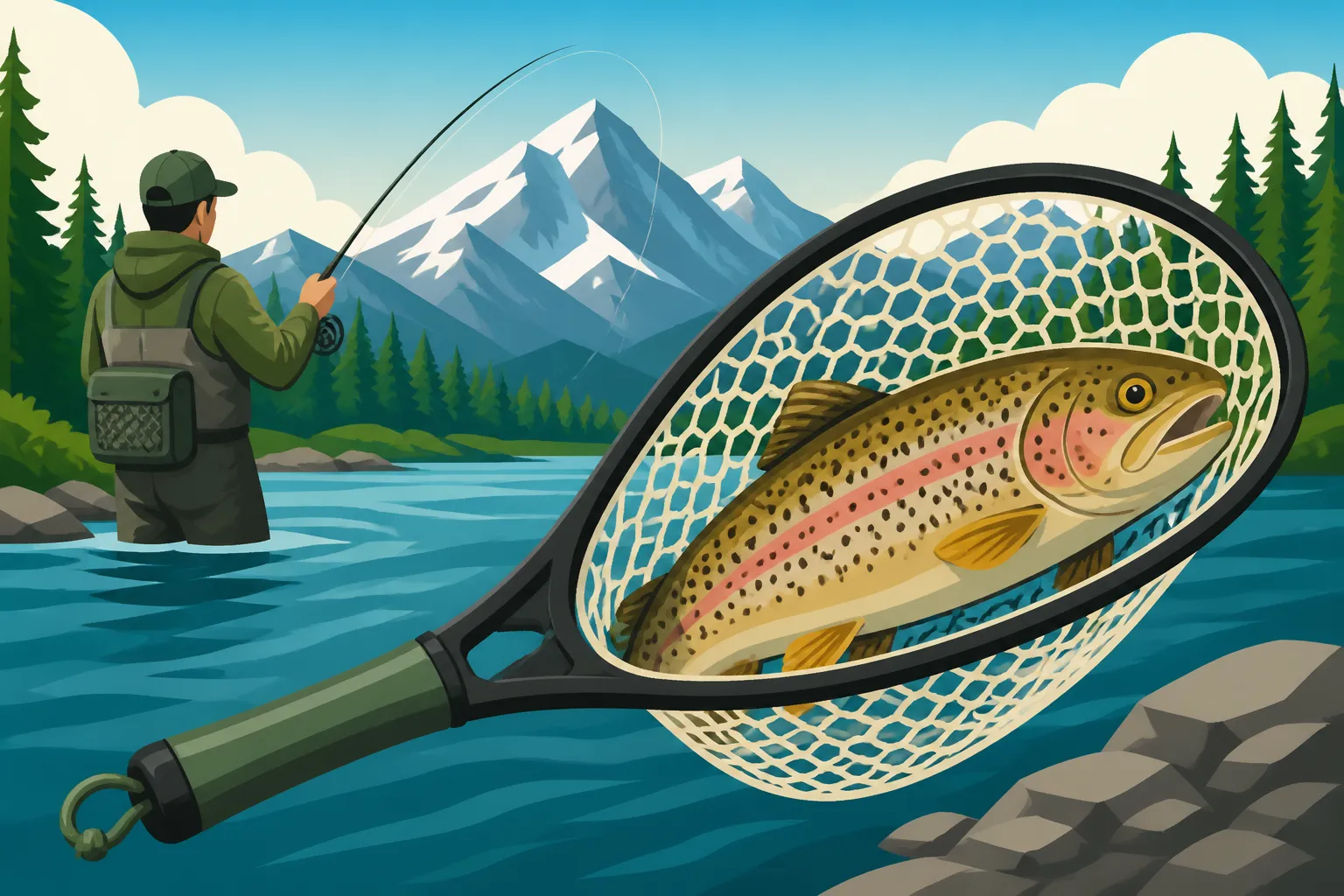
Perhaps the most crucial feature of any trout net is the material and size of its mesh. For trout, you absolutely want a net with rubberized or silicone mesh. This material is smooth, soft, and much gentler on a fish's delicate skin and fins than traditional knotted nylon. The rubber coating prevents the mesh from absorbing water, which means it won't stink after a few uses, dries quickly, and is significantly less likely to tangle hooks. Nobody wants to spend precious fishing time trying to untangle a treble hook from a knotty net! The material’s slickness also helps preserve the fish's slime coat, a vital protective barrier against disease.
Beyond the material, the mesh size is also important. Larger, knotless mesh is generally preferred for trout. Smaller, tightly woven mesh can sometimes scrape fish scales, and it certainly makes it harder to quickly remove hooks. With wider, rubberized mesh, hooks simply pass through or sit on the surface, making for speedy unhooking and a much less stressful experience for the fish. For those fishing Alberta Catch and Release Only Waters, this feature is non-negotiable.
Handle Length and Portability
The length of your net's handle directly impacts its usability in different fishing scenarios. If you're wading a river like the Crowsnest or the Bow, a shorter handle (around 12-24 inches) is often ideal. It keeps the net compact and out of your way while Wading Techniques for Alberta Trout Rivers, easily attachable to a magnetic release on your back or a D-ring on your wading belt. A short handle allows for quick, one-handed deployment when a fish is close, which is often the case when you're actively wading and casting.
However, if you're fishing from a boat, off high banks, or targeting larger fish, a longer handle becomes indispensable. Telescoping or extendable handles offer the best of both worlds, allowing you to adjust the length as needed. These are great for reaching out to land a fish that might be just a bit too far for a short-handled net, especially if you're fishing solo. When portability is key, look for nets with folding hoops or collapsible handles that can be stowed away easily in a backpack or boat compartment, especially if you're venturing into more remote areas or carrying other gear like a Best Fly Rods for the Bow River.
Net Shape and Hoop Size
The shape and size of the net's hoop might seem minor, but they play a significant role in successful landings. A wider, deeper hoop is generally more effective for trout. A wide hoop provides a larger target, which is incredibly helpful when a lively trout is darting around at the surface. A deeper basket ensures that once the fish is in, it stays in, preventing it from flopping out before you can secure it. This is especially important for larger Brown Trout Fishing in Alberta or those big rainbows that call the Bow River home.
Common shapes include rounded, teardrop, or rectangular hoops. Teardrop or rounded hoops are often preferred by fly anglers or waders as they can be more hydrodynamic in current and less cumbersome to carry. Rectangular hoops sometimes offer a bit more surface area for larger fish, making them popular for boat fishing. Consider the typical size of the trout you expect to catch and the environment you'll be fishing in. A net designed for small brook trout in a high mountain lake will likely be insufficient for a trophy walleye (though we're focused on trout today!), or even a big rainbow from the lower Bow.
Different Types of Trout Nets for Alberta Waters
Just like there are many ways to fish for trout, there are various types of nets designed to meet different needs and preferences. Understanding these types will help you narrow down the best option for your specific Alberta angling adventures, whether you're wading a small stream or trolling a vast lake.
Fixed-Handle Landing Nets
Fixed-handle nets are, as the name suggests, nets with a handle of a permanent length. These are often the most traditional and simplest in design. For many dedicated fly anglers or stream waders, a short, fixed-handle net is the go-to choice. They are incredibly reliable, with no moving parts to break or seize up, and their compact size makes them easy to carry. Typically made with a wooden or composite handle and a rubberized net bag, these nets hang comfortably from a magnetic release on your back or a D-ring on your vest. They're perfect for those intimate moments on a river, where a quick, precise scoop is needed for a trout brought to hand right at your feet.
However, their fixed length can also be a limitation. If you find yourself needing to reach a fish just out of arm's length, or if you're fishing from a boat where the water is a fair distance below you, a fixed-handle net might leave you short. They excel in specific, close-quarters situations, often favored by purists who appreciate their simplicity and classic aesthetic. You'll often see these being used on the renowned trout streams like the Crowsnest River where anglers are often submerged and moving through current.
Telescoping and Foldable Nets
For anglers who need versatility, telescoping and foldable nets are excellent solutions. A telescoping net features a handle that can extend and retract, allowing you to adjust its length to suit various situations. This is a fantastic option for someone who fishes both rivers and lakes, or from both the bank and a boat. You can keep it compact for wading and then extend it when you need extra reach. This adaptability can be a real game-changer when you're not sure what kind of water or fish you'll encounter.
Foldable nets take portability a step further, with a hoop that can collapse down, often allowing the entire net to fold into a much smaller package. This makes them incredibly convenient for backpacking into remote lakes or stowing in tight spaces in a kayak or small boat. Both telescoping and foldable designs are generally made with durable aluminum or composite frames. The only real "downside" might be the slight added weight or the potential for moving parts to wear over time, but modern designs are very robust. If you often find yourself hiking into a pristine spot in Kananaskis Country or exploring different Best Trout Streams in Alberta, a collapsible net could be your best friend.
Magnetic Release and Sling Nets
These aren't so much different net types as they are different carrying systems for fixed or even compact telescoping nets, greatly enhancing their functionality and ease of use. A magnetic release system typically involves a powerful magnet attached to the top of your net handle and another to your vest, belt, or backpack. This allows the net to hang securely out of the way, but with a firm tug, it detaches instantly for quick deployment. This hands-free carrying method is invaluable when you're actively casting, wading, or hiking, ensuring your net is always accessible without being cumbersome.
Sling nets are designed to be worn across your back with a shoulder strap, often with a release mechanism (magnetic or clip) at the top of the handle. This allows the net to be quickly swung around to the front for easy access when a fish is on. Both systems address the common frustration of having your net caught on branches or being unable to reach it quickly when you're in the middle of a fish fight. If you're spending a lot of time walking riverbanks, scrambling over rocks, or navigating brush, a magnetic release or sling system is a fantastic accessory to consider with your chosen net.
Considerations for Specific Alberta Trout Fishing Scenarios
Alberta's diverse landscapes offer an incredible range of trout fishing opportunities, from the powerful currents of its major rivers to the tranquil depths of its mountain lakes. The "best" net isn't universal; it depends heavily on where and how you typically fish. Matching your net to your primary fishing style is key for both convenience and effectiveness.
River Wading vs. Bank Fishing
When you're wading a river like the Bow or the Oldman, especially if you're employing Spring Trout Fishing Techniques for Alberta Streams and moving upstream through the current, a compact, short-handled net with a rubberized basket is almost always the best choice. It needs to be light enough not to tire you out, and small enough not to hinder your casting or snag on your legs as you move. A magnetic release or a simple D-ring attachment on your vest or waders (like the Best Waders for Alberta Trout Rivers) keeps it out of the way until that moment you need it. The shorter handle is ideal for scooping a fish that you've fought close, often right at your feet in the shallow water near the bank.
Bank fishing, on the other hand, can sometimes require a bit more reach. If you're fishing from a higher bank, a steep cut, or over submerged vegetation, a telescoping net can be incredibly beneficial. The ability to extend the handle to bridge the gap between you and the water surface means you can safely land fish that would otherwise be out of reach or require a dangerous scramble down the bank. Think about those beautiful prairie rivers with their eroded banks; a little extra reach can make all the difference.
Boat Fishing on Lakes
If your primary fishing ground is one of Alberta's many trout-rich lakes, like Cold Lake for lake trout or any of the Kananaskis Lakes for rainbows, then your net requirements shift significantly. On a boat, particularly if you're targeting larger fish or species like Lake Trout Fishing in Alberta, you'll want a robust net with a wider, deeper hoop and a longer handle. A fixed-handle net around 4-6 feet in length, or a sturdy telescoping net that can extend to similar lengths, is ideal. The extra length allows you to reach over the side of the boat, even if the fish surfaces a bit further away, and the wider hoop provides a more forgiving target.
Consider the layout of your boat. If you have limited space, a foldable net might be a better option for storage, but ensure it's still sturdy enough for the fish you're after. The key for boat fishing is not just landing the fish, but doing so without putting yourself or the fish in an awkward position. A net that's too small or too short can lead to a fish thrashing around in the boat, potentially hurting itself, or worse, you, with flying hooks. Stores like Bass Pro Shops typically have a good selection of boat nets designed for larger fish and open water.
Catch and Release vs. Harvest
The intention behind your fishing trip, whether it's purely catch and release or if you plan to keep a legal limit, also influences your net choice. For strict catch and release, especially for sensitive species or in Alberta Catch and Release Only Waters, a high-quality, fine, knotless rubber or silicone mesh net is paramount. These nets minimize slime coat removal and fin damage, giving the fish the best chance of survival. The goal is to quickly net, unhook, and release the fish with minimal handling, and a gentle net facilitates this.
If you are fishing with the intention of harvesting (within legal limits and regulations, of course), the type of net material is less critical for the fish's immediate survival, though gentle handling is still good practice. However, a rubberized net still offers significant benefits to the angler. Its slick surface means hooks rarely get tangled, making unhooking faster and safer for you. Plus, they're much easier to clean after a day of fishing, as fish slime and scales don't adhere to them like they do to traditional nylon. Regardless of intent, a net that protects the fish is always a win-win, as it also protects your time and sanity. For sheer convenience, many anglers turn to online retailers like Amazon to find a wide array of options quickly, often with detailed descriptions about mesh types and sizes.
Maintaining Your Trout Net for Longevity
A good landing net is an investment, both for your fishing success and for the well-being of the fish you catch. Like any piece of fishing gear, proper care and maintenance will ensure your net lasts for many seasons, continuing to perform reliably when that trophy trout is finally on the line. Neglecting your net can lead to degradation of the mesh, rust on metal components, or even a breakdown in structural integrity at the worst possible moment.
Cleaning and Storage Tips
After every fishing trip, especially if your net has been used, take a few minutes to clean it properly. For rubberized or silicone nets, this is usually a quick rinse with fresh water. You'll be amazed how little grime and slime cling to them. If there's any stubborn dirt or a lingering smell, a mild soap and water solution can be used, followed by a thorough rinse. Avoid harsh chemicals, as these can degrade the rubber over time. For traditional nylon nets, cleaning is even more important as they tend to absorb odors and biological material.
Once clean, ensure your net is completely dry before storing it. Hanging it in a well-ventilated area, out of direct sunlight, is ideal. Storing a wet net can lead to mildew, rot in the handle, or corrosion of metal parts. If you have a telescoping or foldable net, retract and fold it for storage, but don't force it into too tight a space. Store it somewhere where it won't be exposed to extreme temperatures or direct prolonged UV light, which can degrade plastic or rubber components. A garage, shed, or dedicated storage locker is usually perfect.
Repairing Minor Damage
Even with the best care, nets can suffer minor damage. The good news is that many common issues are easily repairable, extending the life of your net and saving you from having to buy a new one. Small tears or punctures in rubberized mesh can often be patched using a waterproof adhesive or a dedicated rubber repair kit, similar to those used for waders or inflatable boats. It's a good idea to inspect your net regularly for these small imperfections before they become big problems.
For nets with wooden handles, occasional sanding and re-sealing with a marine-grade varnish or oil can prevent water damage and cracking. Metal components, like hinges on foldable nets or the frame itself, might occasionally need a drop of lubricant or a rust-inhibiting spray if you notice any stiffness or corrosion. Don't be afraid to tighten screws or bolts that might have loosened over time. These small acts of maintenance can make a huge difference in the longevity and reliability of your net, ensuring it's ready for action for years to come.
Net Types for Alberta Trout Fishing
| Net Type | Ideal Use Case for Alberta Trout Fishing | Pros | Cons |
|---|---|---|---|
| Fixed-Handle | Wading small to medium rivers, close-quarters fly fishing. | Simple, durable, lightweight, easy to deploy quickly. | Limited reach, not ideal for high banks or large boats. |
| Telescoping | Versatile for both river wading and boat/bank fishing. | Adjustable reach, good for varied conditions, more compact for travel. | Moving parts can wear, potentially heavier or less rigid than fixed. |
| Foldable Hoop | Backpacking into remote lakes, kayak fishing, tight storage. | Highly portable, compact storage. | May be less rigid when fully extended, hinges can be failure points. |
| Sling / Magnetic | Active wading, fly fishing, hands-free carrying. | Excellent portability, quick access, keeps net out of the way. | Requires additional vest/belt attachment, potential for magnet failure. |
Disclaimer
This article is for general informational purposes only and does not constitute professional advice. Laws, prices and regulations vary by location and change over time. Consult a qualified professional for guidance on your specific situation.