Best paddle length for a fishing kayak
It's a frustration many of us have faced, whether we're just starting out or have been casting lines in Alberta for years: you get out on the water, excited for a day of fishing from your kayak, only to realize your paddle feels… off. Maybe it's too short, leaving you splashing water all over yourself with every stroke, or perhaps it's too long, making every pull feel awkward and inefficient, wearing out your shoulders long before the fish even start biting. Choosing the right paddle length isn't just about comfort; it’s about efficiency, staying power, and ultimately, making your fishing experience enjoyable and productive. This guide is here to walk you through exactly how to pick the perfect paddle length for your fishing kayak, ensuring your time on the water is spent reeling in fish, not fighting your gear.
Why Paddle Length Matters So Much for Fishing Kayaks
When you're out on the water, especially in Alberta's bigger lakes like Lesser Slave Lake or even navigating the slower sections of the Bow River, your paddle is your primary means of propulsion and control. For fishing kayaks, this is even more critical because these specialized boats often have unique characteristics that demand a specific approach to paddle selection. It's not just about moving forward; it's about subtle maneuvering, efficient travel, and reducing fatigue so you can focus on the fishing.
Efficiency and Reducing Fatigue
Imagine trying to paddle a wide, stable fishing kayak with a paddle designed for a sleek, narrow touring boat. You'd be constantly reaching out too far, bending at awkward angles, and likely hitting the sides of your kayak repeatedly. This isn't just annoying; it's a huge waste of energy. Every inefficient stroke saps your strength, turning what should be a relaxing day into a grueling workout for your shoulders and back. A paddle that's too short forces you to lean excessively, creating drag and making each stroke less powerful. Conversely, a paddle that's too long makes it hard to maintain a proper stroke angle, causing you to lift the paddle higher than necessary and wasting energy on unnecessary movement.
The right paddle length allows for a fluid, powerful stroke that minimizes effort and maximizes propulsion. This means you can cover more water, reach those prime fishing spots further away, and still have plenty of energy left for casting, retrieving, and fighting fish. Think of it as tuning your engine; the better the paddle length matches your kayak and body, the smoother and more efficient your "ride" will be. This efficiency is paramount when you're targeting elusive species in large, open waters or spending long hours on the water.
Stability and Control for Fishing
Fishing kayaks are often wider than their recreational counterparts, designed for maximum stability to allow anglers to stand, cast, and even land larger fish without fear of tipping. While this stability is a huge advantage, it means you need a paddle that can comfortably reach the water without requiring excessive leaning. A paddle that's too short for a wide fishing kayak will have you constantly leaning and over-extending, which can compromise your balance and even lead to an unexpected swim – not ideal when you're loaded with gear and hooks!
The correct paddle length provides a comfortable and effective reach, allowing you to maintain your balance effortlessly while maneuvering your kayak. This control is vital for precise positioning, whether you're holding steady against a gentle current on a river like the Oldman or adjusting your drift to work a shoreline on one of Alberta's many productive lakes. It also makes subtle adjustments, like turning to cast at a rising trout or quickly pivoting to follow a hooked walleye, much easier and more intuitive. Your paddle becomes an extension of your intent, rather than a hindrance.
Casting and Landing Fish
Beyond just paddling, your chosen paddle length can directly impact your ability to fish effectively. Picture this: you've finally found a school of walleye, and you need to make a quick, accurate cast. If your paddle is awkwardly long, it can get in the way, snagging on your line or limiting your casting motion. You might find yourself having to constantly lay it across your lap or secure it in a paddle holder, which takes time and attention away from the fish.
A well-sized paddle allows you to seamlessly transition between paddling and fishing. It's short enough not to interfere with your casting arm but long enough to provide quick, responsive strokes when you need to adjust your position. Furthermore, when you hook into a big northern pike or a feisty lake trout, you'll appreciate a paddle that can be quickly stowed or doesn't impede your ability to brace, lean, and fight the fish. The last thing you want is your paddle getting tangled in your line or banging against your rod during the heat of the battle. Best Landing Net for Pike or Best Landing Net for Trout become much easier to manage when your paddle isn't fighting you.
Factors Influencing Your Ideal Paddle Length
Choosing the right paddle length isn't a one-size-fits-all situation. Several key factors come into play, and understanding them will help you make an informed decision tailored to your specific setup and fishing style. It’s all about creating harmony between you, your kayak, and your paddle.
Kayak Width
This is arguably the most significant factor for fishing kayaks. Fishing kayaks, designed for stability, are often much wider than recreational or touring kayaks. The wider your kayak, the longer your paddle needs to be to comfortably reach the water and get a clean, efficient stroke without banging your knuckles on the gunwales or having to lean excessively. If you're paddling a broad, stable platform designed for standing and casting, a shorter paddle will feel like you're constantly fighting to get enough blade in the water, leading to splashes and inefficient movement.
Think about a common fishing kayak, which might be anywhere from 30 to 40 inches wide. Compare that to a touring kayak at 24 inches wide. That extra width means you need a substantial increase in paddle length to maintain a comfortable, vertical stroke angle. Without it, you'll be overreaching and straining your shoulders, especially when trying to maintain speed or paddle against a stiff headwind on a large body of water like Cold Lake. Many anglers discover this the hard way, thinking a standard paddle will do, only to end up sore and frustrated after an hour on the water.
Angler Height and Torso Length
While kayak width is paramount, your own body dimensions, particularly your height and torso length, play a crucial role. Taller paddlers, especially those with longer torsos, will naturally need a longer paddle to maintain a comfortable stroke angle, regardless of the kayak's width. This is because your seated position dictates how high your hands are above the water line. If you're a tall angler in a relatively narrow kayak, you still might need a longer paddle than a shorter person in the same boat, simply due to your extended reach.
A good rule of thumb often involves holding the paddle upright in front of you. With the blade touching the ground, your top hand should comfortably reach the top of the paddle shaft with your arm slightly bent. However, this is a starting point and needs to be refined with the other factors. If you're unsure, or if you plan to share your kayak, adjustable paddles can be a fantastic option, allowing you to fine-tune the length for different users or even different seating positions within the same outing. Many excellent adjustable options can be found through retailers like Bass Pro Shops or online at Amazon.
Seating Position (High vs. Low)
Modern fishing kayaks often feature adjustable seating, allowing you to sit in a lower "travel" position for paddling efficiency or a higher "fishing" position for better visibility and easier casting. This is a game-changer for anglers, but it directly impacts your paddle length requirement. When you raise your seat, your seated height above the water increases significantly. This means you’ll need a longer paddle to maintain the same efficient stroke angle and comfortably reach the water.
If you primarily paddle in a high seat position, you'll need a paddle that is considerably longer than if you were always in a low seat. Many anglers opt for a paddle length that accommodates their most common, or highest, paddling position. Some savvy anglers even carry two different paddles or, more commonly, use an adjustable paddle to switch lengths on the fly. For instance, if you're covering long distances to get to a fishing spot, you might use a shorter length in a low seat for more efficient paddling, then extend it when you raise your seat for casting. This adaptability is key for maximizing comfort and effectiveness throughout your fishing day.
Paddling Style and Preferences
Believe it or not, your individual paddling style can also influence your ideal paddle length. Some anglers prefer a more aggressive, high-angle stroke, where the paddle blade enters the water closer to the kayak and is pulled with more vertical power. This style often favors a slightly shorter paddle, as it allows for quicker, more frequent strokes. Others prefer a more relaxed, low-angle stroke, where the paddle blade enters the water further out from the kayak and is pulled in a flatter arc. This style typically benefits from a slightly longer paddle, providing more leverage and a smoother, less strenuous pull over longer distances.
Consider the type of water you'll be fishing and your typical paddling habits. Are you covering vast stretches of a large prairie lake, or are you making short, precise movements in a small creek? Are you a power paddler or do you prefer a leisurely pace? These preferences, combined with your kayak's characteristics and your body type, will help fine-tune your ultimate choice. There's no single "perfect" length for everyone, but by considering these elements, you can find the length that feels most natural and efficient for you.
Measuring Up: How to Determine Your Perfect Paddle Length
Okay, so we've talked about why paddle length matters and the factors that influence it. Now, let's get down to the nitty-gritty: how do you actually figure out the right length for your specific fishing kayak setup? It's not as complicated as it might seem, and a few simple measurements can get you pretty darn close.
The "Kayak Width + Angler Height" Method
This is one of the most reliable methods for determining an appropriate paddle length for fishing kayaks, as it directly accounts for the two most critical variables: how wide your kayak is and how tall you are. The general principle is that the wider the kayak and the taller the paddler, the longer the paddle needed. This method helps compensate for the extra reach required to get a good, efficient stroke in a broad, stable fishing platform.
Here's how you do it:
- Measure Your Kayak's Width: Get an accurate measurement of your kayak's width at its widest point. This is usually near the cockpit or where you sit. Be precise!
- Determine Your Seated Height: Sit in your kayak in your preferred fishing position (usually the higher seat setting, if applicable). Have a friend measure the distance from the water's surface (or the bottom of the hull if on land) up to your chin or nose. This gives you an idea of your "effective" height above the water.
- Consult a Sizing Chart (or use a general formula): While specific charts vary, the idea is to combine these measurements. A rough guide often suggests:
- For kayaks 30-32 inches wide:
- Angler 5'0" – 5'7": 230-240 cm
- Angler 5'8" – 6'2": 240-250 cm
- Angler 6'3"+: 250-260 cm
- For kayaks 33-35 inches wide:
- Angler 5'0" – 5'7": 240-250 cm
- Angler 5'8" – 6'2": 250-260 cm
- Angler 6'3"+: 260 cm+
- For kayaks 36+ inches wide (often found in larger tandem or stand-up fishing kayaks):
- You'll likely need paddles in the 250-280 cm range, often favoring the longer end of that spectrum, especially for taller paddlers.
- For kayaks 30-32 inches wide:
Remember, these are starting points. If you have particularly long or short arms relative to your height, or if you prefer a very high or very low paddling angle, you might need to adjust slightly. It's always best to try a paddle in your actual kayak if possible, or at least be prepared to make an exchange if the initial choice doesn't feel quite right.
The "Arm Reach" Test (A Quick Check)
While not as precise as the height and width method, the arm reach test can be a quick and handy way to get a ballpark figure, especially if you're just browsing paddles. This method helps gauge if a paddle is fundamentally in the right range for your body, though it doesn't account for kayak width.
Stand the paddle vertically on the ground in front of you, with one end resting on your toes. Your fingers should be able to comfortably wrap around the top of the T-grip or the top edge of the blade (if it's an asymmetrical blade). If you have to really stretch or stand on your tiptoes, the paddle is likely too long. If your hand falls well below the top with a straight arm, it might be too short.
Again, this is a very rough guide and mostly applicable to traditional recreational kayaking where the seat isn't elevated. For fishing kayaks with their unique design elements, the "kayak width + angler height" method is far superior. However, for a quick initial assessment when you're looking at a rack of paddles, it can give you a starting point before you dig into the specifics of your boat.
Considering Adjustable Paddles
For many fishing kayakers, an adjustable paddle is the ultimate solution. These paddles allow you to change their length, typically within a 10-20 cm range, often with a simple lever lock mechanism. This flexibility is invaluable, especially if you:
- Have a fishing kayak with a high/low seat position.
- Anticipate using your paddle for different kayaks (e.g., a wide fishing kayak and a narrower recreational one).
- Are still fine-tuning your paddling style and preferences.
- Fish with varying gear loads that might change your kayak's trim and effective freeboard.
The ability to adjust your paddle length on the fly means you can optimize for different conditions. A shorter setting might be great for powerful, quick strokes when navigating tight spaces or fighting a strong headwind. A longer setting could be ideal for relaxed, low-angle paddling across a large lake, maximizing efficiency and minimizing fatigue. Many anglers find the slight weight penalty of an adjustable paddle a small price to pay for this versatility. When browsing for fishing kayak paddles, especially from online retailers like Amazon, pay attention to models that offer this adjustability.
Here's a simplified table to help you visualize paddle length recommendations based on kayak width and angler height, which is a great starting point for Alberta anglers:
| Angler Height Range | Kayak Width (28-30 inches) | Kayak Width (31-34 inches) | Kayak Width (35+ inches) |
|---|---|---|---|
| Under 5'5" | 220-230 cm | 230-240 cm | 240-250 cm |
| 5'5" to 5'11" | 230-240 cm | 240-250 cm | 250-260 cm |
| 6'0" to 6'4" | 240-250 cm | 250-260 cm | 260-270 cm |
| Over 6'4" | 250-260 cm | 260-270 cm | 270-280 cm |
Remember this is a general guide; individual preference and specific kayak design can influence the ideal length.
Common Paddle Lengths and When to Use Them
Knowing the numbers is one thing, but understanding the practical application of different paddle lengths can really help you choose wisely. Most kayak paddles fall into a few general length categories, and each has its sweet spot.
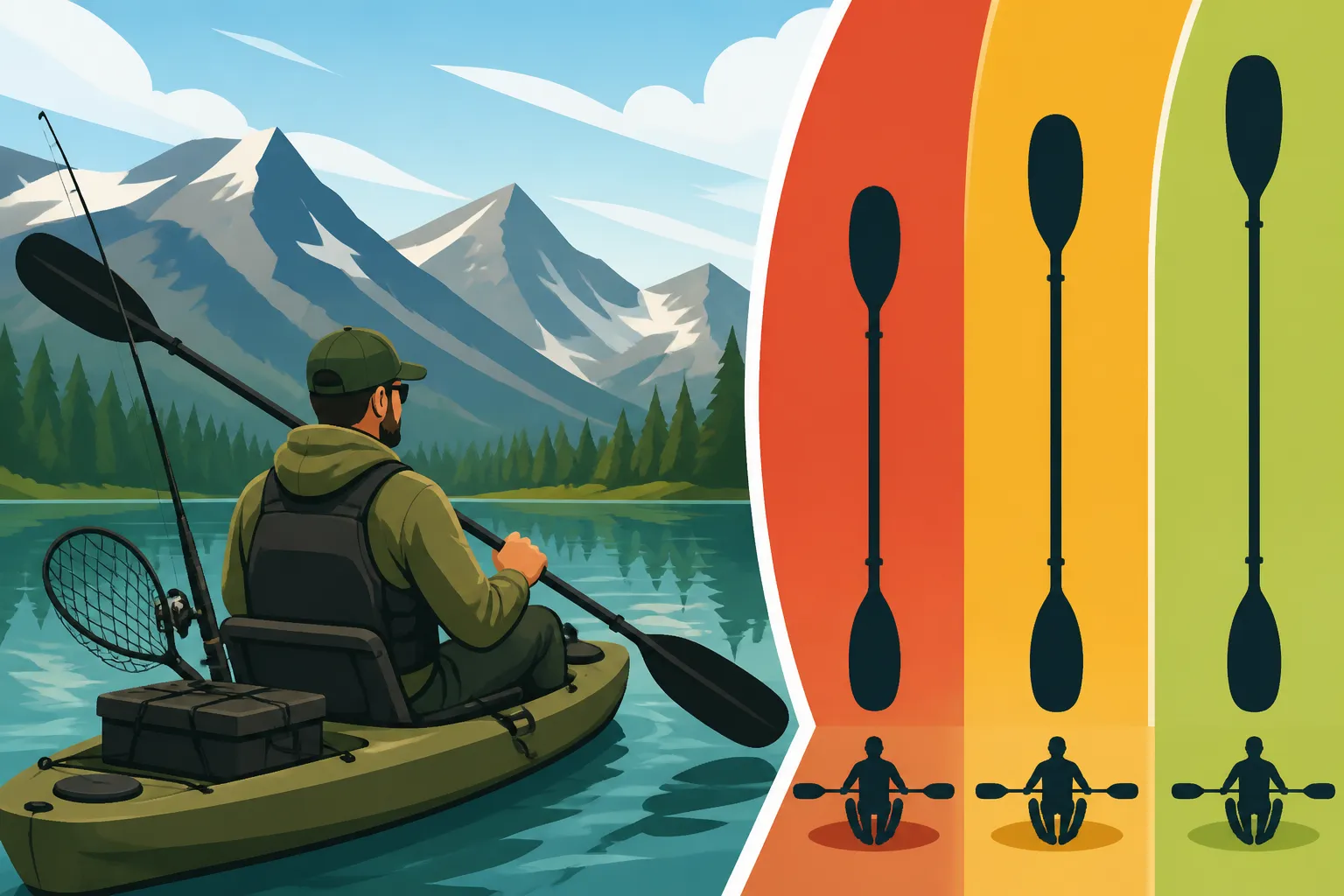
Shorter Paddles (220-230 cm)
Paddles in the 220-230 cm range are generally considered "shorter" and are best suited for specific scenarios and kayak types. You'll typically find these recommended for:
- Narrow Kayaks: If you're using a recreational kayak that's on the narrower side (think less than 28 inches wide), or a touring kayak, a shorter paddle can be very efficient. These kayaks don't require as much reach to get the blade in the water effectively. However, fishing kayaks are rarely this narrow, so it's less common for our purposes.
- Shorter Anglers in Moderately Wide Kayaks: A shorter angler (under 5'5") might find a 230 cm paddle perfectly adequate even in a moderately wide fishing kayak (say, 30-32 inches), especially if they primarily paddle from a lower seat position. The key is that their arms are not overly extended, and they can maintain a comfortable, close-to-the-body stroke.
- Aggressive, High-Angle Paddling: Anglers who prefer a higher-angle stroke – where the paddle enters the water more vertically, closer to the kayak – might opt for a shorter paddle. This style emphasizes quick, powerful strokes and can be effective for short bursts of speed or precise maneuvering in tight spots, such as navigating a small channel in a marshy area near Calling Lake.
The downside to a paddle this length in a typical fishing kayak is a higher chance of hitting the gunwales, more splashing, and a less efficient stroke due to insufficient blade submersion, especially if you're sitting in a high seat. It can lead to unnecessary fatigue over a long day. If you find yourself splashing constantly or feeling like you're reaching too far down, your paddle is likely too short for your setup.
Medium Paddles (230-250 cm)
This is the sweet spot for many, many fishing kayakers in Alberta and beyond. Paddles in the 230-250 cm range offer a great balance of reach, power, and comfort for a wide variety of fishing kayaks and anglers.
- Standard Fishing Kayak Widths: Most fishing kayaks fall into the 30-34 inch width range, and a paddle between 230 cm and 250 cm is often the ideal match. It allows for a comfortable, efficient stroke without excessive leaning or over-reaching, whether you're paddling on Pigeon Lake or navigating a larger river. This range accommodates the higher seating positions that are so popular in fishing kayaks, providing enough length to get the blade fully in the water without strain.
- Average Height Anglers: Anglers of average height (5'5" to 6'0") will find this range very comfortable in most fishing kayak setups. It provides the necessary leverage for propulsion while minimizing arm and shoulder fatigue, making it perfect for long days chasing walleye or pike.
- Versatile for High/Low Seats: For fishing kayaks with adjustable high/low seats, an adjustable paddle within this range (e.g., 230-240 cm or 240-250 cm) offers the perfect flexibility. You can shorten it slightly for the low seat position for efficient travel and lengthen it for the high seat position when you're actively fishing. This versatility is why many anglers opt for adjustable models available at places like Bass Pro Shops.
If you're unsure where to start, an adjustable paddle in the 230-250 cm range is often a very safe bet for the typical Alberta fishing kayak. It provides enough adaptability to fine-tune your comfort and efficiency.
Longer Paddles (250 cm and up)
For certain situations and specific types of fishing kayaks, a longer paddle becomes not just an option, but a necessity. Paddles in the 250 cm and up range are designed to tackle the unique challenges of very wide kayaks or exceptionally tall paddlers.
- Very Wide Fishing Kayaks: If your fishing kayak is on the wider side, say 35 inches or more (think larger tandem kayaks, specialized stand-up fishing platforms, or some older, exceptionally stable models), you're going to need a longer paddle. These kayaks demand maximum reach to get the paddle blade past the wide hull and into the water effectively. Trying to use a shorter paddle would result in a lot of splashing and highly inefficient strokes, feeling like you're constantly fighting your boat.
- Taller Anglers (6'3"+): Even in a moderately wide fishing kayak, a very tall angler with a long torso will likely benefit from a paddle in the 250 cm+ range. Their increased seated height requires a longer shaft to achieve a natural, comfortable stroke angle. This is particularly true if they favor a high seat position.
- Low-Angle Paddling Preference: Anglers who prefer a very relaxed, low-angle paddling style, where the paddle blade enters the water further away from the kayak, might also gravitate towards longer paddles. This provides more leverage for a long, smooth stroke that can be less fatiguing over extended periods, making it ideal for cruising along the shores of larger lakes. Kayak Fishing Techniques for Alberta Lakes often benefit from this kind of relaxed efficiency.
While a longer paddle provides excellent reach, a paddle that is too long can be cumbersome, leading to awkward strokes, increased arm fatigue due from lifting unnecessary weight, and difficulty with quick maneuvers. It's all about finding that balance point where you get maximum reach without sacrificing control or comfort. Many specialized fishing kayak paddles can be found at these longer lengths, and checking reviews on Amazon can often provide insights into how they perform with different kayak models.
Paddle Construction and Features to Consider
Beyond length, the material and design of your paddle can significantly impact your comfort and performance on the water. It's worth a moment to consider these aspects, as they contribute to the overall feel and longevity of your paddle, which is just as important as getting the length right for your Best Kayaks for Alberta Fishing.
Material Matters: Weight and Durability
Paddle shafts and blades come in various materials, each with its own pros and cons in terms of weight, durability, and cost.
- Aluminum: Often found in entry-level paddles, aluminum shafts are durable and affordable. However, they can be heavier, making long paddling sessions more fatiguing. They also tend to feel colder in the hand in cooler Alberta weather and can corrode if not properly maintained after saltwater exposure (though less of a concern for most Alberta freshwater anglers).
- Fiberglass: A popular mid-range option, fiberglass paddles offer a good balance of lighter weight and increased strength compared to aluminum. They are warmer to the touch and provide a bit more flex, which can be easier on the joints over time. Many quality fishing kayak paddles feature fiberglass construction.
- Carbon Fiber: The lightest and often most expensive option, carbon fiber paddles are prized for their stiffness and feather-light feel. This significantly reduces fatigue, especially on long paddling days or when fighting strong winds. If you're serious about minimizing effort and maximizing performance, a carbon fiber paddle is a worthwhile investment. However, they can be more brittle than fiberglass if subjected to sharp impacts.
For the blade material, you'll often see reinforced nylon, fiberglass, or carbon. Nylon is robust and affordable but can be a bit heavier and less efficient (more flex). Fiberglass and carbon blades are lighter, stiffer, and more efficient, transferring more power with each stroke.
Blade Design: Efficiency and Power
Paddle blades aren't all created equal. Their shape and size influence how much water they catch and how they feel during a stroke.
- Asymmetrical, Spoon-Shaped Blades: These are common for recreational and touring paddles. They are designed to be efficient, providing a smooth pull through the water. For fishing kayaks, these work well for covering distance.
- Larger Blades: Some fishing-specific paddles feature slightly larger blades. These provide more "grab" on the water, offering instant power for quick maneuvers, turning the kayak quickly to face a fish, or digging in against a sudden gust of wind. This extra power can be useful, but also means more effort per stroke.
- Dihedral Angle: Many blades have a slight ridge down the middle (dihedral angle). This helps the water flow smoothly off both halves of the blade, reducing flutter and making the stroke more stable and less tiring.
Think about your primary use. If you're covering long distances, a more efficient blade might be preferable. If quick, powerful bursts are more important for holding position or rapid turning, a larger blade might be better.
Ferrule Type: Two-Piece vs. Four-Piece and Feathering
Most kayak paddles break down into two pieces for easy transport and storage, which is incredibly convenient for anglers. Some touring paddles or emergency paddles might break into four pieces.
- Two-Piece Paddles: These are standard. The ferrule (the joint where the two pieces connect) often allows for "feathering," which means you can adjust the angle of one blade relative to the other. Common feathering angles are 0 degrees (unfeathered), 30 degrees, 45 degrees, or 60 degrees. Feathering helps reduce wind resistance on the blade that's out of the water, especially useful on windy days on open lakes like Gull Lake. However, for many fishing kayakers, an unfeathered (0-degree) or slight feather (30-degree) is comfortable for casting and easy handling.
- Adjustable Ferrules: Many modern paddles feature an adjustable ferrule that allows for infinite feathering angles within a certain range, or at least multiple indexed settings. This is another layer of customization that adds to comfort. Some high-end paddles also have adjustable length built into the ferrule, further increasing versatility.
The right paddle, combining ideal length with suitable materials and blade design, becomes a seamless extension of your body and your kayak. It transforms your time on the water, reducing fatigue and allowing you to fully immerse yourself in the joy of Alberta fishing. Whether you're making a purchase at Bass Pro Shops or browsing countless options on Amazon, keep these construction details in mind to find a paddle that truly enhances your angling experience.
Disclaimer
This article is for general informational purposes only and does not constitute professional advice. Laws, prices and regulations vary by location and change over time. Consult a qualified professional for guidance on your specific situation.