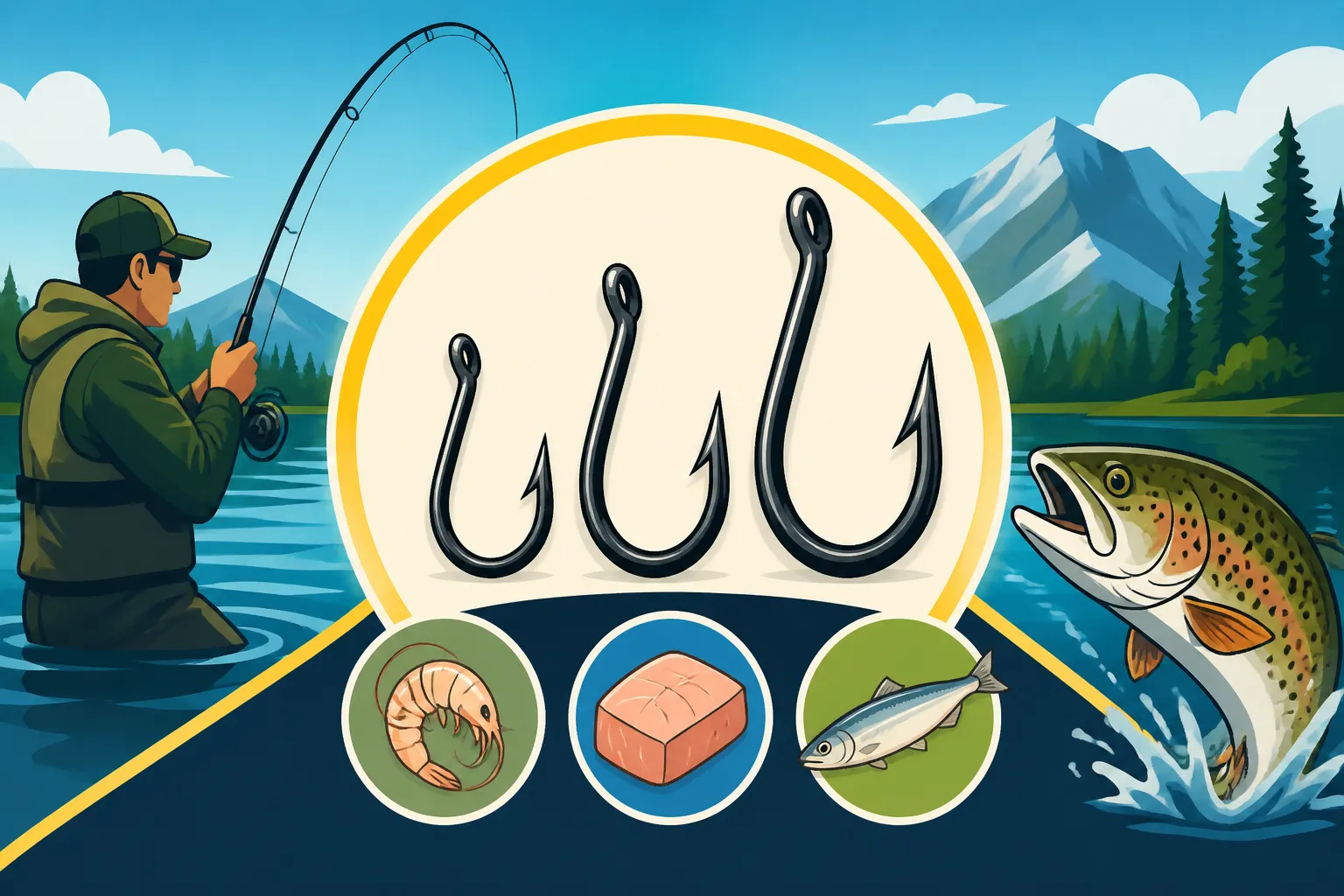
Best circle hook size for bait fishing
For many anglers in Alberta, the frustration of deep-hooked fish is a common and disheartening experience, especially when using traditional J-hooks with bait. This often leads to unnecessary stress on the fish and can significantly reduce their chances of survival after release. This comprehensive guide is here to shed light on the unsung hero of ethical bait fishing: the circle hook, and precisely how to choose the right size for the diverse species swimming in Alberta's lakes and rivers, ensuring healthier catches and releases for everyone.
Why Circle Hooks Are Your Best Bet for Alberta Bait Fishing
Let's face it, we all want to enjoy our time on the water, but we also want to be responsible stewards of Alberta's fisheries. Traditional J-hooks, while effective, often lead to fish swallowing the hook, resulting in gut-hooked or gill-hooked fish that are unlikely to survive, even if released. This is where circle hooks truly shine, transforming your bait fishing experience into something more ethical, effective, and ultimately, more satisfying.
Ethical Angling and Fish Survival
The primary advantage of circle hooks lies in their design, which is inherently safer for fish. Unlike J-hooks that can easily lodge in a fish's throat or stomach, circle hooks are designed to slide to the corner of the fish's mouth as the line tightens. This almost always results in a lip-hook, which is far less damaging and significantly increases the survival rate of released fish. For species like bull trout, which have a strict Alberta Bull Trout Zero Possession Rule, or any fish you intend to release, using circle hooks is not just a recommendation—it's a commitment to conservation. It's about ensuring those fish swim away healthy to be caught another day, contributing to the long-term health of our aquatic ecosystems.
When you're out targeting walleye on Lesser Slave Lake or casting for trout in a mountain stream, knowing that your gear is designed for minimal impact gives you peace of mind. Many anglers are making the switch, realizing that the slight adjustment in technique is a small price to pay for the immense benefit to the fish. Think of it as a small change with a big ripple effect on our valuable fish populations.
Better Hook-Up Ratios
Beyond the ethical considerations, many anglers find that circle hooks actually improve their hook-up ratios, especially when fishing with natural baits. The unique shape of the circle hook means that as a fish takes the bait and swims away, the hook naturally pivots and catches in the corner of its mouth without the need for a forceful hookset. This "self-setting" mechanism can be incredibly effective, particularly for those times when you're distracted, or for beginners still getting the hang of traditional hook setting.
Imagine you're out on a peaceful morning, sipping coffee, and watching your rod tip. With a J-hook, you'd need to be ready to strike at just the right moment. With a circle hook, that moment becomes less critical. The fish helps set the hook itself as it moves off with the bait. This passive yet effective hooking action means fewer missed bites due to mistimed hooksets and more fish landed cleanly. This reliability is especially appreciated when you're fishing in less-than-ideal conditions or simply enjoying a relaxing day without constant vigilance.
Self-Setting Design
The "self-setting" nature of circle hooks is perhaps their most defining characteristic and one that takes a bit of getting used to if you're accustomed to traditional J-hooks. The key principle is: do not set the hook. When a fish bites and begins to move, simply apply steady pressure by slowly reeling in. The hook will rotate and slide into the corner of the fish's mouth, securing the catch. A hard, sweeping hookset, as you would use with a J-hook, will often pull the circle hook right out of the fish's mouth.
This unique action not only reduces harm to the fish but also simplifies the fishing process in many ways. It allows you to fish multiple rods more effectively, or simply relax more while waiting for a bite. It’s a game-changer for new anglers or kids, who can find the timing of a traditional hookset challenging. Once you get the rhythm of letting the fish do the work, you'll wonder how you ever fished bait without them. This design principle is a testament to how intelligent tackle design can make a real difference in both enjoyment and conservation.
Decoding Circle Hook Sizing: What Numbers and "O" Mean
Navigating the world of fishing hook sizes can sometimes feel like trying to solve a cryptic puzzle. You see numbers like #10, #2, 1/0, and 5/0, and it's not immediately obvious what they all mean in relation to each other or to the fish you're targeting. Understanding this sizing system is fundamental to selecting the right circle hook for your Alberta adventures, whether you're chasing tiny perch or large pike.
Standard Sizing System Explained
For smaller hooks, commonly used for panfish or smaller trout, the sizing system works in reverse: the larger the number, the smaller the hook. So, a size #10 hook is smaller than a #8, which is smaller than a #6, and so on. This continues down to #1, which is generally the largest hook in this numbering series. Think of it like a shoe size for little feet – the numbers represent increasingly smaller hooks as they go up.
This system is common for finesse fishing applications where you might be using smaller baits like worms, maggots, or small pieces of cut bait. For instance, if you're targeting yellow perch in a local pond, a #8 or #6 circle hook would be a good starting point. The goal is to match the hook size not only to the fish's mouth but also to the bait you're presenting, ensuring the hook point remains exposed for effective self-setting. You can find excellent selections of these smaller hooks in multi-packs at stores like Bass Pro Shops, making it easy to experiment.
The "Aught" Sizing for Larger Hooks
Once you move past the #1 size, the system flips, and we enter the "aught" sizes, denoted with a forward slash and a zero (e.g., 1/0, 2/0, 3/0). In this system, the larger the number before the "/0", the larger the hook. So, a 1/0 hook is smaller than a 2/0, which is smaller than a 3/0, and so on. This can go up to very large sizes, like 10/0 or even higher for offshore fishing, though for most Alberta species, you'll rarely need to go much larger than a 5/0.
These aught-sized hooks are your go-to for larger fish species like walleye, northern pike, and burbot. They accommodate bigger baits such as minnows, leeches, or larger chunks of cut bait. When you're rigging up for a serious Walleye Fishing in Alberta trip on a big lake, a 2/0 or 3/0 circle hook will likely be in your tackle box. It’s important to visualize the fish's mouth and the bait you plan to use – the hook needs to be large enough to hold the bait securely while still allowing the hook point to be exposed for that critical corner-of-the-mouth catch.
Factors Beyond Just the Number
While the number system provides a baseline, it's crucial to remember that hook sizes can vary slightly between manufacturers and even between different hook models. A 2/0 circle hook from one brand might be marginally different in gap or wire diameter than a 2/0 from another. Always visually inspect the hook and consider its overall dimensions.
Beyond the numerical size, think about the wire diameter (how thick the metal is) and the gap (the distance between the hook point and the shank). For toothy fish like pike, a stronger, heavier wire might be preferred to prevent bending or breaking. For more delicate presentations or finicky fish, a finer wire hook might be advantageous. The bait itself plays a huge role; the hook needs to be able to pass through the bait and still have enough exposed point to grab hold. You can often find detailed product specifications on online retailers like Amazon, which can help compare different options.
Matching Circle Hook Size to Alberta Fish Species
Now that we've unravelled the sizing system, let's get down to the nitty-gritty: pairing the perfect circle hook size with some of Alberta's most popular sport fish. Choosing the right hook isn't just about the fish's size; it's also about the shape of its mouth, its feeding habits, and the type of bait you're using.
Walleye and Perch
Walleye and perch are often targeted together, especially in many of Alberta's productive lakes. They both have relatively soft mouths and are often caught using similar baits.
For walleye, especially when using popular baits like minnows, leeches, or nightcrawlers, you'll generally want to lean towards the smaller end of the "aught" scale. A 1/0 or 2/0 circle hook is often the sweet spot. These sizes are large enough to securely hold a shiner or a good chunk of a worm, but not so large that they deter a cautious walleye or struggle to fit into its mouth. If you're using larger minnows or fishing for bigger walleye, you might occasionally bump up to a 3/0, but it's rarely necessary. The key is to ensure the hook point is exposed from your bait. For more on targeting these delicious fish, check out How to Catch Walleye in Alberta and Best Baits for Walleye on Lesser Slave Lake.
Yellow perch, with their smaller mouths, require a significantly smaller hook. Here, you'll be delving into the standard number system. A #6 or #8 circle hook is ideal for perch, especially when using small pieces of worm, maggots, or tiny minnows. Sometimes, even a #10 can be effective if the perch are exceptionally finicky or small. The goal is a hook that is proportional to their mouth size and the small offerings they prefer. Going too large will result in missed bites, as they simply won't be able to get the hook in their mouth properly.
Northern Pike and Burbot
These two species represent different challenges but can both be effectively targeted with larger circle hooks.
Northern pike are notorious for their toothy grins and aggressive strikes. While many anglers prefer artificial lures for pike, bait fishing with large minnows or cut bait can be incredibly effective. For pike, you'll need a sturdier, larger circle hook to accommodate their large mouths and prevent the hook from being swallowed. A 3/0 to 5/0 circle hook is typically recommended. The larger sizes ensure the hook point is well clear of your bait and can securely catch in the corner of their powerful jaws. Given their sharp teeth, always consider using a wire leader to prevent bite-offs, even with a circle hook. Remember, the goal is a lip-hook, which is safer for both the fish and for your fingers when unhooking! Explore more about these formidable predators in Northern Pike Fishing in Alberta and Best Pike Gear for Alberta Lakes.
Burbot, often called "freshwater cod," are bottom dwellers with surprisingly large mouths for their body size. They're typically targeted with cut bait or pieces of fish on the bottom. For burbot, a 2/0 to 4/0 circle hook works very well. Their mouths are designed to engulf prey, and the circle hook ensures a solid, clean hookset in the lip as they take the bait and move away. Since burbot are often caught in colder, deeper water and sometimes ice fishing, handling them carefully upon retrieval is always a good practice.
Trout and Whitefish
Alberta boasts incredible trout fisheries, from the mighty Bow River to countless mountain streams, and mountain whitefish are a common bycatch and a worthy target in their own right. These species generally have smaller, more delicate mouths compared to pike or walleye, requiring a more refined approach to hook sizing.
For trout (rainbow, brown, cutthroat, etc.), especially when bait fishing with worms, salmon eggs, or powerbait, you'll typically want small, sharp circle hooks. Sizes ranging from #8 to #4 are usually perfect. A #6 is often considered a versatile all-around choice for many trout scenarios. The size depends heavily on the bait – a tiny salmon egg will need a smaller hook (like a #8 or #10), while a half nightcrawler might accommodate a #4 or #2. The key is presenting the bait naturally while leaving the hook point exposed. For those pursuing trout on famed waters, look at Rainbow Trout Fishing on the Bow River for more specific techniques.
Mountain whitefish are similar to trout in their mouth size and feeding habits, often found in the same rivers. They respond well to smaller presentations like tiny worms, nymphs, or even small pieces of corn. For whitefish, a #8 or #6 circle hook is usually ideal. They have relatively small, downward-facing mouths, and a smaller, sharp hook ensures they can easily take the bait and get hooked cleanly. Remember that Alberta Bag and Possession Limits by Species apply to all fish, including whitefish, so be sure to check the regulations for your specific fishing zone.
Here's a handy table summarizing recommended circle hook sizes for common Alberta species:
| Species | Common Baits | Recommended Circle Hook Sizes (Standard #) | Recommended Circle Hook Sizes (Aught /0) | Notes |
|---|---|---|---|---|
| Walleye | Minnows, Leeches, Nightcrawlers, Cut Bait | #1, #2 | 1/0, 2/0, (3/0 for large baits) | Match hook to bait size; ensure point exposed. |
| Northern Pike | Large Minnows, Cut Bait, Smelt | 3/0, 4/0, 5/0 | Use heavy wire leader; lip-hook is key. | |
| Lake Trout | Large Minnows, Cut Bait, Herring | 3/0, 4/0, 5/0 | Often fished deep; strong wire preferred. | |
| Burbot | Cut Bait (sucker, herring), Worms | #1, #2 | 2/0, 3/0, 4/0 | Good for ice fishing; strong wire. |
| Rainbow Trout | Worms, Salmon Eggs, Powerbait, Marshmallows | #6, #8, (#4 for larger baits) | Small, sharp hooks for delicate mouths. | |
| Brown Trout | Worms, Minnows, Powerbait, Crickets | #6, #8, (#4 for larger baits) | Similar to Rainbow Trout, slightly larger hooks for larger baits. | |
| Cutthroat Trout | Worms, Small Nymphs, Crickets | #8, #10 | Finesse presentation for sensitive mouths. | |
| Yellow Perch | Maggots, Small Worms, Micro Minnows | #8, #10 | Smallest hooks for small mouth and delicate bites. | |
| Mountain Whitefish | Small Worms, Nymphs, Corn | #8, #6 | Often caught as bycatch; require small baits. |
Tips for Rigging and Fishing with Circle Hooks in Alberta
Making the switch to circle hooks is straightforward, but there are a few nuances that can greatly improve your success. It's not just about selecting the right size; it's also about understanding how these hooks interact with your bait and the fish.
Proper Bait Presentation
With circle hooks, how you rig your bait is paramount. The critical rule is to always leave the hook point exposed. If the hook point is buried in your bait, it won't be able to rotate and catch in the corner of the fish's mouth effectively. This is especially true for the point, which should ideally be facing back towards the shank.
For worms or nightcrawlers, thread the worm onto the hook, but ensure the hook point and barb are clearly visible outside the worm. For minnows, hook them lightly through the lips or just behind the dorsal fin, making sure the hook's gap and point are unobstructed. If you're using cut bait, a good strategy is to pass the hook through the toughest part of the bait once, leaving the majority of the hook exposed. When you buy your hooks, whether at a local tackle shop or through an online retailer like Amazon, you'll often see diagrams on the packaging illustrating ideal bait presentations.
Don't Set the Hook (Just Reel!)
This is arguably the most crucial piece of advice for fishing with circle hooks. Resist the urge to yank your rod to "set" the hook when you feel a bite. That aggressive motion, so ingrained in many of us from years of J-hook fishing, will almost always pull the circle hook right out of the fish's mouth without ever getting a proper grip.
Instead, when you feel a bite or see your rod tip bend, simply pick up the rod, point it towards the fish, and begin to slowly and steadily reel in. The tension from the line and the fish's movement will cause the hook to pivot and slide into the corner of its mouth. Maintain steady pressure, and you'll find the fish is securely hooked. This takes a little practice to overcome muscle memory, but once you trust the hook's design, your hook-up ratio will likely improve, and your fish will be healthier for it. This technique works wonders whether you're leisurely bank fishing or actively trolling.
Essential Tackle Considerations
While circle hooks do a lot of the work for you, your overall tackle setup still plays an important role. Your rod, reel, and line should be appropriately matched to the fish you're targeting.
For most Alberta bait fishing, a medium-light to medium action spinning rod is a versatile choice. The softer tip will allow the fish to take the bait without feeling too much resistance, and the backbone will provide enough power to fight the fish once it's hooked. Pair this with a reliable spinning reel spooled with monofilament or fluorocarbon line. Monofilament has some stretch, which can be forgiving with circle hooks, absorbing sudden movements from the fish. Fluorocarbon is less visible and more abrasion-resistant, which can be beneficial in clear waters or around rocky structure.
Remember that a wire leader is a must when targeting toothy northern pike, regardless of the hook type. Even with a circle hook intended for the lip, a pike's sharp teeth can still sever your mainline. Always have a good selection of Best Tackle for Alberta Walleye and Best Lures for Northern Pike in Alberta in your box, in addition to your circle hooks. Choosing the right tackle complements the benefits of circle hooks, ensuring a smooth and successful fishing experience in Alberta's beautiful waters.
Disclaimer
This article is for general informational purposes only and does not constitute professional advice. Laws, prices and regulations vary by location and change over time. Consult a qualified professional for guidance on your specific situation.