Best Fish Finder for Deep Lake Fishing
There's nothing quite like the immense feeling of potential that comes with staring out over a vast, deep Alberta lake. You know those trophy fish are down there, lurking in the cold, dark depths, but finding them can feel like searching for a needle in a haystack. The sheer size and profound depths of lakes like Cold Lake, Lake Athabasca, or even parts of Lesser Slave Lake can make traditional shallow-water tactics utterly useless. This guide is all about equipping you with the knowledge to pick the absolute best fish finder specifically designed to conquer those challenging deep-water environments, helping you pinpoint structure, bait, and those elusive lunkers hidden beneath the surface.
Why Deep Water Presents a Unique Challenge for Fish Finders
Fishing in the shallows is one thing; you can often see the bottom, spot weed lines, or even sight-fish. But when you're out on a massive lake with hundreds of feet of water beneath your keel, it's a completely different ball game. The physical properties of water itself, coupled with the vast distances your sonar signal has to travel, create significant hurdles for standard fish-finding technology. Without a unit designed for these conditions, you're essentially fishing blind.
Signal Strength and Cone Angle Degradation
Imagine yelling across a football field versus trying to have a conversation across a vast canyon. That's a bit like what happens to your sonar signal in deep water. As the sound waves travel further, they naturally lose intensity. A weak signal simply won't have enough power to bounce off a fish or structure at 150, 200, or even 400 feet down and return a clear, interpretable echo to your transducer. It just dissipates into the abyss.
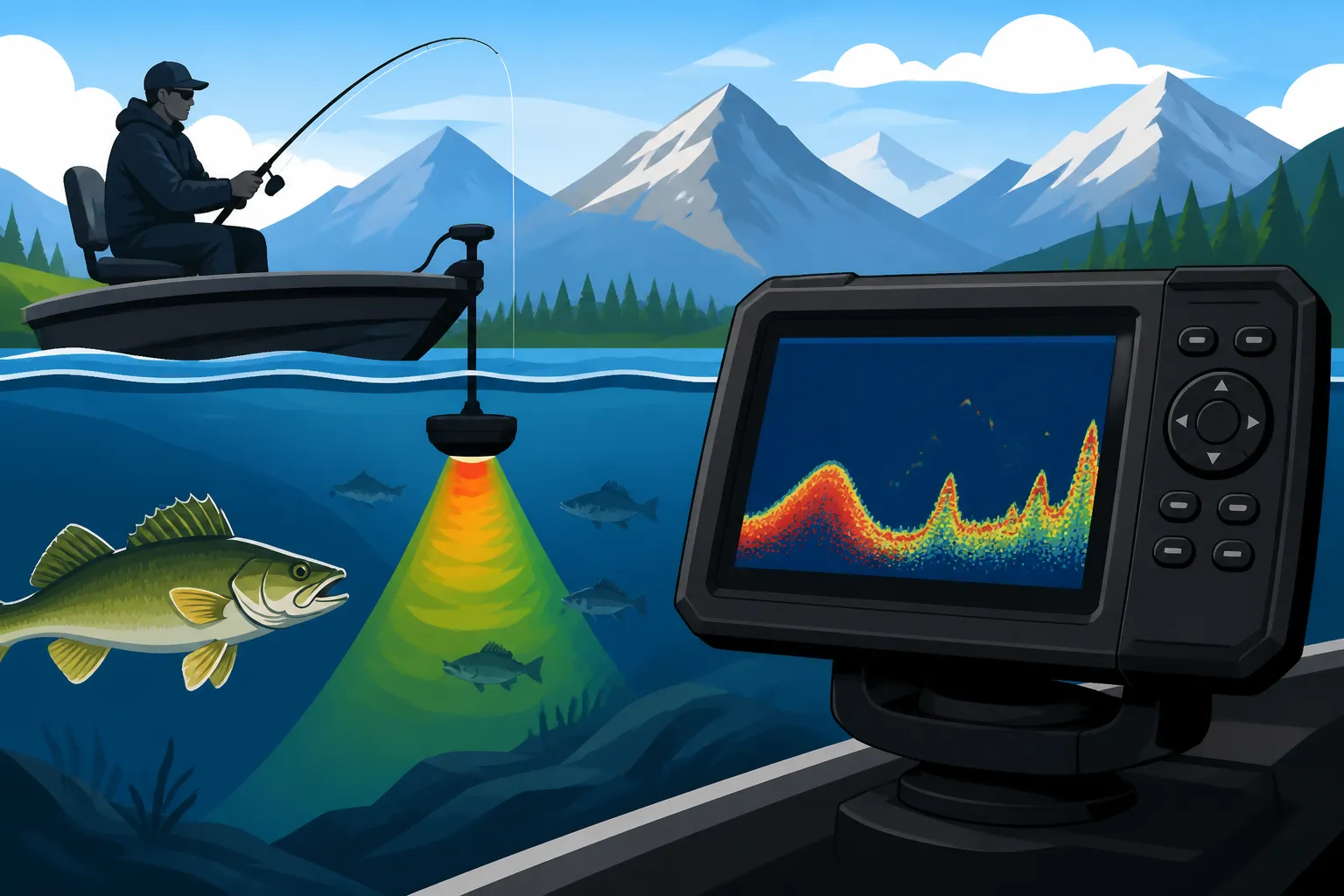
Furthermore, the cone angle of your sonar beam widens dramatically with depth. While a wider cone might sound good in theory for covering more ground, in deep water, it becomes a problem. What starts as a focused beam directly under your boat expands into a massive, diluted circle by the time it reaches the bottom. This means targets appear as broad, indistinct blobs, and you lose precious detail and target separation. You might see "something" down there, but you'll have no idea if it's a school of bait, a lone lunker, or just some bottom debris. For anglers targeting specific species like the immense lake trout found in Cold Lake Lake Trout Fishing scenarios, this clarity is absolutely non-negotiable. You need a fish finder that can punch through that vast amount of water with enough focused power to bring back a coherent picture.
Identifying Structure vs. Fish in the Abyss
In shallower waters, distinguishing between a log, a rock pile, or a fish is often quite clear on a decent fish finder. The returns are strong, and the shapes are distinct. However, in the profound depths of Alberta's larger lakes, everything can start to look ambiguous. Thermoclines, which are layers of water with different temperatures, can appear as hazy lines on your screen, sometimes mimicking schools of baitfish. Dense concentrations of zooplankton or even underwater currents can also generate confusing returns.
The challenge is further compounded when trying to discern a single, large fish from a smaller school or a piece of sunken structure. The fish finder needs to have exceptional target separation capabilities – the ability to differentiate between two objects that are very close together. Without it, that monster lake trout lurking just above a rocky ledge might simply blend into the bottom contour on your screen. You need to be able to confidently identify that crucial deep-water structure, such as submerged humps, ledges, or old river channels, which are prime holding areas for fish. Then, on top of that, you need to see the fish themselves with enough clarity to know they're not just a false reading.
Essential Technologies for Deep Lake Fish Finders
When you're dealing with serious depth, standard fish finder technology simply won't cut it. The advancements in sonar technology over the past decade have been a godsend for deep water anglers, providing the power and clarity needed to unlock the secrets of the abyss. Understanding these core technologies is the first step to choosing the right unit.
CHIRP Sonar: The Game Changer for Depth
If you're serious about deep lake fishing, CHIRP (Compressed High-Intensity Radiated Pulse) sonar is not just a nice-to-have; it's virtually essential. Traditional sonar sends out a single frequency pulse, which is effective to a point but struggles with power and detail at depth. CHIRP, on the other hand, sends out a continuous sweep of frequencies, from low to high, with each pulse. Think of it like a symphony of sound waves instead of a single note.
This frequency sweep offers several incredible advantages for deep water. Firstly, it puts significantly more energy into the water, meaning a much stronger signal can penetrate deeper and still return a clear echo. Secondly, because it analyzes a range of frequencies, the receiver can "hear" a much more detailed picture. This translates to vastly improved target separation – you can discern individual fish even when they're tightly schooled or sitting right on top of structure. It also provides crystal-clear images with less noise and interference, making it easier to interpret what you're seeing in those dark, deep zones. When you're trying to locate a school of walleye suspending over a deep basin on Lesser Slave Lake, or marking individual fish close to the bottom, CHIRP sonar is your best friend. Different CHIRP ranges are also important: low CHIRP penetrates the deepest, while medium and high CHIRP offer increasing detail in shallower water, making a full-range CHIRP system incredibly versatile.
Down Imaging and Side Imaging in Deeper Water
While traditional 2D CHIRP sonar is fantastic for vertical target identification, Down Imaging (DI) and Side Imaging (SI) offer photographic-like views of what's directly beneath or to the sides of your boat. These technologies use higher frequencies and thinner, fan-shaped beams to create incredibly detailed images. For shallow and medium depths, they are unparalleled for identifying structure and cover.
However, in deep water, there are some important considerations. Down Imaging still provides excellent detail for what's directly below your boat, helping you pick out subtle ledges, rock piles, or sunken trees with incredible clarity, even at significant depths. It's like looking at an underwater photograph. Side Imaging, while revolutionary for covering vast swaths of water, does have its limitations in extreme depth. The effective range of Side Imaging decreases as the water gets deeper. For instance, if you're in 200 feet of water, your side range might be significantly less than in 50 feet. Still, even with a reduced range, Side Imaging can be invaluable for sweeping deep drop-offs or exploring expansive flats to quickly locate changes in bottom composition or isolated structure that might hold fish. Using both 2D CHIRP and Down/Side Imaging in conjunction allows you to paint a comprehensive picture of the deep-water environment, giving you the best of both worlds.
GPS and Mapping: More Than Just Navigation
In the immense expanse of Alberta's deep lakes, a reliable GPS and detailed mapping capabilities are far more than just navigation tools; they are integral to successful deep-water fishing. Imagine you're marking a promising deep rock pile, or you've found a thermocline where fish are suspending. Without precise GPS, finding that exact spot again, especially in open water with no obvious landmarks, is nearly impossible.
Modern fish finders often come pre-loaded with highly detailed charts for major lakes, showcasing contours, depths, and navigation aids. Look for units that offer high-definition contour mapping, revealing even subtle changes in bottom topography that indicate prime fish-holding structure. The ability to create your own custom maps, marking waypoints for brush piles, humps, or even individual fish you've spotted, is an absolute game-changer. Features like track plotting allow you to follow precise routes, troll along contour lines, or return to a productive drift path with pinpoint accuracy. This is especially vital when practicing Trolling Techniques for Alberta Lake Trout, where staying on a specific depth or structure edge can make all the difference. When you factor in the sheer size of lakes like Lake Athabasca or Lesser Slave Lake, having a robust GPS and mapping system means you can confidently explore, mark, and return to productive deep-water zones without ever feeling lost.
Key Features to Look for in a Deep Water Fish Finder
Once you understand the underlying technologies, it's time to dive into the specific features that elevate a good fish finder to a great deep-water fish finder. These are the elements that directly impact its ability to perform under pressure in challenging conditions.
Transducer Power and Frequency Options
The transducer is the heart of your fish finder, sending and receiving the sonar signals. For deep water, its power output, measured in RMS (Root Mean Square) wattage, is paramount. More RMS power means the signal can penetrate deeper, cut through noise, and still deliver a strong return echo. Don't skimp on power for deep lake applications; it's probably the most critical specification. While peak-to-peak power (PTP) numbers might look impressive, RMS is the true indicator of consistent power.
Equally important are the frequency options. Lower frequencies, such as 50 kHz or the low CHIRP range (e.g., 28-60 kHz), excel at deep penetration. They provide a broader view and can reach hundreds, even thousands, of feet down with less signal degradation. However, they offer less detail. Higher frequencies, like 200 kHz or high CHIRP (e.g., 150-240 kHz), provide much finer detail and better target separation, but their effective depth penetration is reduced. The ideal scenario for deep water fishing is a multi-frequency or full-range CHIRP transducer that allows you to use low frequencies for maximum depth and then switch to medium or high frequencies when you want to refine your search in a specific depth range or analyze a target more closely. Some transducers even combine traditional 2D, Down Imaging, and Side Imaging elements into a single unit, providing incredible versatility.
Screen Resolution and Size
In deep water, the information displayed on your screen can be complex. You're often looking at subtle returns, faint arcs, or fine contour lines that distinguish a structure from a fish, or a bait ball from a thermocline. A large, high-resolution screen is absolutely crucial for accurately interpreting this data. Trying to discern details on a small, low-resolution screen in deep water is like trying to read fine print in the dark – frustrating and ineffective.
Aim for the largest screen you can comfortably fit on your boat and within your budget. Look for models with a high pixel count (e.g., 1024×768 or higher is excellent). A higher pixel density means sharper images, more distinct target separation, and the ability to split your screen into multiple views (e.g., 2D CHIRP, Down Imaging, and a map) without sacrificing too much detail in each window. Color screens are standard now and vastly superior to monochrome for distinguishing different types of returns. Also, consider the screen's brightness and anti-glare properties, especially if you fish on bright, sunny days common to Alberta summers. The ability to see your screen clearly, regardless of lighting conditions or viewing angle, is essential for continuous monitoring of deep-water activity.
User Interface and Ease of Use
While deep water fish finders are packed with advanced technology, a clunky or non-intuitive user interface can turn a powerful tool into a source of frustration. When you're actively fishing, you don't want to be fumbling through multiple menus just to adjust a setting or mark a waypoint. The best units for deep water manage to combine cutting-edge features with a user-friendly design.
Look for fish finders that offer straightforward navigation, ideally with dedicated buttons for frequently used functions or quick-access presets that you can customize. Touchscreen interfaces have become popular and can be very intuitive for zooming, scrolling, and marking waypoints, though some anglers prefer physical buttons for tactile feedback, especially in rough water or with wet hands. The learning curve for deep water fish finders can be steeper than for basic units due to the sheer number of settings and display options. However, a well-designed interface with clear menus, comprehensive on-screen help, and intuitive controls can significantly reduce this learning period, allowing you to focus more on fishing and less on the gadget. Remember, the goal is to enhance your fishing experience, not complicate it.
Integrating Your Fish Finder with Your Fishing Style
A fish finder isn't just a static display; it's an interactive tool that should seamlessly integrate with how you fish. For deep lake anglers, this means leveraging its capabilities whether you're covering vast distances or precisely presenting a lure in the water column.
Trolling and Drifting Over Deep Structure
Deep lake fishing, especially for species like lake trout, often involves extensive trolling or drifting. Your fish finder becomes the command center for these operations. It allows you to constantly monitor the bottom contours, identify submerged humps, drop-offs, and deep weed lines, and keep your boat in the prime strike zone. The GPS capabilities, as discussed earlier, are invaluable for this. You can mark a productive trolling pass, follow it precisely, and if you get a strike, immediately mark a waypoint to return to that exact spot.
Features like auto-charting, where the unit creates or refines depth contours as you move, can be incredibly helpful for building a detailed map of unfamiliar deep structure. This allows you to identify subtle changes in the bottom that might hold fish, which are otherwise invisible. When you're running multiple lines at various depths, understanding the underwater topography from your fish finder helps you prevent snags and keeps your lures in the most productive zones. For instance, successfully deploying Trolling Techniques for Alberta Lake Trout demands a clear understanding of depth changes and fish locations, which a powerful deep-water fish finder provides. It transforms guesswork into a strategic, informed approach, allowing you to systematically work through vast deep-water areas and pinpoint where the fish are holding.
Vertical Jigging and Ice Fishing Deep Waters
For those who prefer a more hands-on approach, vertical jigging, especially in deep water, relies heavily on immediate, precise feedback from your fish finder. Imagine dropping a jig 100 feet down into a dark abyss; you need to know exactly where that lure is in relation to any fish you've marked. Many modern fish finders designed for deep water will feature a "flasher" mode or a real-time sonar display that shows your lure's descent and any fish that come into its cone in near real-time. This allows you to make precise depth adjustments to entice a bite.
This real-time feedback is also absolutely indispensable for Ice Fishing in Alberta, particularly for deep-dwelling species like burbot or lake trout. From the ice, you're usually fishing a very small, fixed area, and the ability to see your bait, the fish approaching it, and their reaction is critical. Excellent target separation ensures you can tell if that "blip" on the screen is your small tungsten jig or a curious fish. When that fish moves in, you can adjust your jigging action to trigger a strike. Without this level of detail and responsiveness, deep water vertical presentations become a shot in the dark, and your success rate will plummet. Units that perform well in this vertical, real-time context often have specific modes or sensitivities optimized for it.
Top Considerations When Purchasing Your Deep Lake Fish Finder
Choosing a fish finder for deep lake fishing is a significant investment, and like any big purchase, there are several practical factors beyond just the technology that you need to weigh carefully.
Budget vs. Performance Expectations
Let's be realistic: high-performance deep-water fish finders aren't usually cheap. The advanced CHIRP transducers, powerful processors, large high-resolution screens, and sophisticated mapping capabilities all come at a cost. It's easy to get caught up in the "dream" unit, but it's important to set a realistic budget. Generally, the deeper and more detailed you want to go, the more you'll need to spend.
However, that doesn't mean you can't find excellent options at various price points. Instead of focusing solely on the most expensive unit, prioritize the features that are absolutely essential for your deep-water fishing style. For example, if lake trout fishing is your primary goal, strong 2D CHIRP and GPS mapping might be more critical than top-tier Side Imaging. If you mostly vertical jig, a unit with excellent real-time flasher capabilities might be key. Check out reputable marine electronics retailers like Bass Pro Shops, or browse online marketplaces such as Amazon, to compare prices and features across different brands. Sometimes, a slightly older model from a premium brand can offer incredible deep-water performance at a reduced cost compared to the newest flagship units.
Installation and Transducer Mounting
Even the most advanced deep-water fish finder will underperform if its transducer isn't properly installed. This is particularly true for deep-water applications, where signal interference or a poor angle can severely impact performance. There are several mounting options, each with pros and cons:
- Transom Mount: The most common and easiest to install, this mounts on the boat's stern. However, it can be prone to turbulence and interference at higher speeds, which can affect deep-water readings.
- Thru-Hull Mount: This involves drilling a hole in the hull and provides the cleanest signal by getting the transducer directly into undisturbed water. It's often the preferred choice for serious deep-water anglers but requires professional installation for many.
- In-Hull Mount (Shoot-Thru): The transducer is epoxied inside the hull, shooting through the fiberglass. This offers protection and no drag but can lead to some signal loss, especially in deeper water or with thicker hulls.
- Trolling Motor Mount: Convenient for smaller boats or kayak fishing, but the transducer is less powerful than dedicated thru-hull units and is limited to the trolling motor's location.
For optimal deep-water performance, a well-placed thru-hull transducer or a high-quality transom mount (if a thru-hull isn't feasible) is often recommended. Ensure the transducer is positioned to avoid propeller wash, aerated water, or other sources of interference. The cleaner the water flow over the transducer, the clearer your deep-water readings will be.
Brands and Ecosystems
The marine electronics market for fish finders is dominated by a few major players, each with their loyal following and distinct features. Brands like Garmin, Lowrance, and Humminbird are well-known for their robust deep-water capabilities. While specific model recommendations aren't part of this guide, generally speaking, these brands offer a range of units that excel in deep-water environments, often differentiated by their proprietary sonar technologies (e.g., Garmin's UHD scanning, Lowrance's ActiveTarget, Humminbird's MEGA Imaging).
When choosing, it's not just about the individual fish finder, but sometimes the "ecosystem" it belongs to. If you plan to expand your electronics setup in the future – perhaps adding a trolling motor with integrated sonar, radar, or a second display – sticking with a single brand can simplify networking and compatibility. Many brands offer seamless integration across their product lines. Researching user reviews and comparing features across these top brands, available at stores like Bass Pro Shops or online through Amazon, will help you narrow down the best fit for your deep-water angling adventures in Alberta. The consistency in menu navigation and software updates within an ecosystem can also be a significant benefit over time.
Deep Water Fish Finder Features Comparison
To help you visualize the crucial aspects of a deep water fish finder, here's a comparison of features you'll commonly find and why they matter for challenging depths:
| Feature Category | Basic Fish Finder (Shallow/Medium) | Advanced Deep Water Fish Finder | Why It Matters for Deep Water |
|---|---|---|---|
| Sonar Technology | Traditional 2D Sonar (single frequency) | CHIRP (Low, Medium, High) + Down/Side Imaging | CHIRP provides superior target separation and depth penetration; DI/SI offer photographic views of structure. |
| Transducer Power | 200-500W RMS | 600W-1kW+ RMS | Higher power is essential for strong signals to reach extreme depths and return clear echoes. |
| Frequencies | 200/83 kHz | 50/200 kHz, Low/Medium/High CHIRP | Lower frequencies penetrate deepest; multi-frequency CHIRP offers versatility for depth and detail. |
| Screen Size/Res | 5-7 inches, 480×272 pixels | 9-16 inches+, 800×480 to 1280×800+ pixels | Large, high-res screens allow clearer interpretation of subtle deep-water returns and split-screen viewing. |
| GPS & Mapping | Basic GPS, minimal mapping | Advanced GPS, detailed pre-loaded charts, custom mapping, auto-charting | Crucial for marking and returning to deep-water structure/fish, creating precise contour maps. |
| Target Separation | Adequate for shallow water | Excellent (e.g., 1-2 inches) | Distinguishes individual fish from schools, structure, and bait in deep water. |
| Real-time Sonar | Limited or basic | Dedicated flasher mode, fast refresh rates | Essential for vertical jigging and Ice Fishing in Alberta to see lure and fish interaction. |
| Networking Cap. | None or limited | Fully networkable (Ethernet, NMEA 2000) | Connects to other marine electronics (trolling motor, radar, additional screens) for a holistic system. |
Equipping yourself with the right fish finder for deep lake fishing in Alberta is a total game-changer. It transforms a guessing game into a strategic hunt, allowing you to confidently explore, locate, and ultimately catch those incredible fish lurking in the depths. Whether you're chasing the behemoth lake trout of Cold Lake, or the elusive walleye in the deep basins of Lesser Slave, the right technology makes all the difference. Remember to consider your specific fishing style, budget, and the features that truly empower you on the water. With the proper gear, those deep-water mysteries will start to reveal their secrets to you, and your fishing adventures in Alberta will reach a whole new level. Good luck out there, and tight lines!
Disclaimer
This article is for general informational purposes only and does not constitute professional advice. Laws, prices and regulations vary by location and change over time. Consult a qualified professional for guidance on your specific situation.