Best trailer hitch setup for a small jon boat
Hauling your small jon boat out to your favourite fishing hole in Alberta should be an exciting part of your day, not a source of stress and worry. Too many anglers struggle with hitches that aren't quite right, leading to shaky rides, worn-out gear, or even safety hazards on the road. This comprehensive guide is here to walk you through everything you need to know about setting up the best trailer hitch for your small jon boat, ensuring a secure and smooth journey every single time.
Understanding Your Jon Boat and Trailer
Before you even think about connecting anything to your vehicle, you need to understand the fundamental specifications of your jon boat and its trailer. This isn't just about knowing if your boat fits on the trailer; it's about crucial weight distribution, capacity limits, and how these factors dictate the type of hitch setup you'll need. Skipping this step is like trying to build a house without checking the foundation – you're just asking for trouble down the line.
Assessing Boat and Trailer Specifications
Every trailer has a Gross Vehicle Weight Rating (GVWR), which is the maximum loaded weight it can safely carry, including the trailer's own weight and the boat, motor, and all your gear. For a small jon boat, this might seem straightforward, but it's surprising how quickly those tackle boxes, fuel tanks, and coolers add up. You also have the Gross Axle Weight Rating (GAWR), which specifies the maximum weight that can be supported by the axle(s). It's crucial that your boat and its contents don't exceed these limits. Overloading a trailer not only puts undue stress on the axles and tires but also dramatically impacts your vehicle's braking and handling, making for a dangerous towing experience.
Even more critical for hitch selection is the tongue weight. This is the downward force exerted by the trailer coupler onto your vehicle's hitch. Generally, the tongue weight should be 10-15% of the total loaded trailer weight for a stable towing experience. If your tongue weight is too low, the trailer can sway wildly, a phenomenon known as "fishtailing" that can quickly lead to loss of control. If it's too high, it can sag your vehicle's rear, reducing steering control and braking efficiency. You can measure tongue weight using a specialized scale or by carefully using a bathroom scale with a lever system for lighter setups, but always be cautious and consult your trailer manual. Understanding these numbers is the bedrock of a safe towing setup. You can't guess when it comes to safely moving your prized possession down the highway.
Types of Jon Boat Trailers
Jon boats are typically small and lightweight, which means their trailers are often simpler, but there are still variations to consider. Most small jon boat trailers are either bunk style or roller style. Bunk trailers use carpeted wooden runners or "bunks" that support the boat's hull. They're generally less expensive and provide excellent support for the hull, distributing the boat's weight evenly. However, launching and retrieving a boat from a bunk trailer can sometimes require submerging the trailer deeper into the water, which can be a bit more challenging in shallow ramps or in colder weather.
Roller trailers, on the other hand, use a series of rollers that the boat rests on, making launching and retrieving a breeze – especially in shallower water or if you're frequently loading and unloading alone. The downside is that roller trailers concentrate the boat's weight on fewer points, which might not be ideal for certain hull types over long periods, though for the robust construction of most jon boats, this isn't typically a major concern. Regardless of the type, ensure your trailer is designed for your specific boat length and beam, and that the lights and tires are in good working order. A well-maintained trailer is just as important as a robust hitch for safe transport, especially if you're trailering often to your favourite spots on Lesser Slave Lake Walleye Fishing or the Bow River Fishing Guide.
Choosing the Right Hitch Components
Once you understand your boat and trailer's demands, it's time to select the actual hitch components that will bridge the gap between your vehicle and your trailer. This isn't a "one-size-fits-all" scenario; selecting the right class, ball mount, and hitch ball is crucial for safety and performance. Getting these pieces wrong can lead to serious issues, from rattling and excessive wear to complete detachment of your trailer, which is every angler's worst nightmare.
Receiver Hitch Classes and Capacity
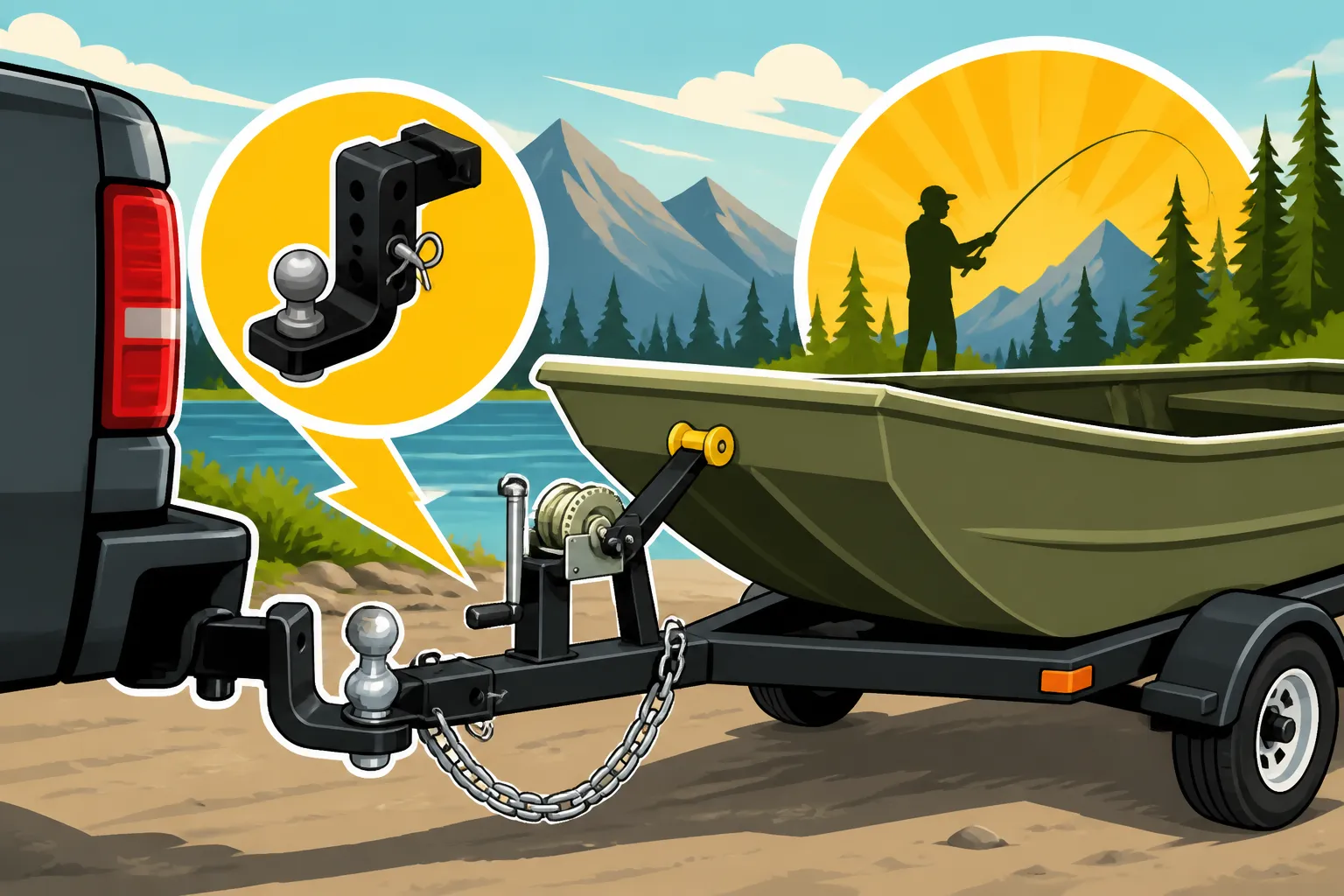
Your vehicle needs a receiver hitch, which is the square tube that mounts to the frame of your tow vehicle. Receiver hitches are categorized by classes, each with a specific Gross Trailer Weight (GTW) and Tongue Weight (TW) capacity. For small jon boats, you'll likely be looking at a Class I or Class II receiver.
- Class I hitches are typically rated for up to 2,000 pounds GTW and 200 pounds TW. These are common on smaller sedans and some compact SUVs. They usually have a 1-1/4 inch receiver opening.
- Class II hitches step up to around 3,500 pounds GTW and 350 pounds TW, often found on minivans, crossovers, and smaller trucks. They also commonly use a 1-1/4 inch receiver opening.
- Class III hitches are the workhorses, rated for up to 5,000 pounds GTW and 500 pounds TW, and are standard on many SUVs and pickup trucks. These almost always feature a 2-inch receiver opening.
While your small jon boat might only weigh a few hundred pounds, it's always better to err on the side of caution and choose a hitch class that comfortably exceeds your total loaded trailer weight. This provides a safety margin and ensures durability. Always check your vehicle's owner's manual for its maximum towing capacity; never exceed what your vehicle is rated for, even if your hitch receiver has a higher rating. You can find a good selection of these at reputable retailers like Bass Pro Shops or online through Amazon, ensuring you get a product that meets industry safety standards.
Ball Mount and Hitch Ball Selection
With your receiver hitch in place, the next step is selecting the correct ball mount and hitch ball. The ball mount is the shank that slides into your receiver and holds the hitch ball. The critical factor here is getting the right amount of "drop" or "rise" to ensure your trailer tows level. A level trailer distributes weight properly across its axle(s) and tongue, ensuring stable towing and even tire wear. To determine the necessary drop or rise, park your tow vehicle on level ground and measure the distance from the top inside edge of your receiver tube to the ground. Then, measure the distance from the bottom of your trailer's coupler (when level) to the ground. The difference between these two measurements will tell you how much drop or rise your ball mount needs.
The hitch ball itself must match the size of your trailer's coupler. Common sizes for small boat trailers are 1-7/8 inch and 2 inch. Using a ball that's too small for the coupler is incredibly dangerous as the trailer could detach. A ball that's too large simply won't fit. Always double-check your trailer's coupler for the correct size stamped on it. Ensure the hitch ball's weight rating also meets or exceeds your trailer's loaded weight. These are relatively inexpensive components, but their proper selection is paramount to your safety and the longevity of your trailer. Don't skimp here; a sturdy, well-matched hitch ball and mount are non-negotiable for a secure tow.
Here's a quick guide to common hitch ball sizes and their typical corresponding trailer capacities:
| Hitch Ball Diameter | Typical GTW Capacity (lbs) | Common Applications |
|---|---|---|
| 1-7/8 inches | 2,000 – 3,500 | Small utility trailers, some small boat trailers |
| 2 inches | 3,500 – 7,500 | Most boat trailers, utility trailers, larger campers |
| 2-5/16 inches | 10,000 – 30,000+ | Heavy-duty trailers, large RVs, commercial use |
For most small jon boats, a 1-7/8 inch or 2 inch ball will be appropriate, but always verify with your trailer's coupler.
Trailer Wiring and Lighting
While not strictly part of the "hitch" itself, proper trailer wiring and lighting are absolutely critical for legal and safe towing. Your trailer's lights – tail lights, brake lights, turn signals, and sometimes side marker lights – must function in sync with your tow vehicle. For most small jon boats, a simple 4-flat (or 4-pin) wiring harness is sufficient. This provides power for the running lights, left turn/brake, right turn/brake, and ground.
If your vehicle doesn't already have a trailer wiring harness, you'll need to install one. This typically involves connecting to your vehicle's existing tail light wiring. While many modern vehicles come "tow-ready" with a factory harness, older models or those not specifically optioned for towing will require an aftermarket installation. Kits are widely available, and while some are plug-and-play, others require splicing wires. If you're not comfortable with electrical work, it's a good idea to have a professional install it. You want those lights to be bright and reliable, especially when you're driving home after a successful day catching walleye or pike, as outlined in How to Catch Walleye in Alberta or How to Catch Northern Pike in Alberta. Remember, faulty trailer lights can lead to traffic tickets, but more importantly, they are a serious safety hazard on the road, as other drivers rely on your signals to anticipate your movements.
Essential Accessories and Safety Checks
Even with the perfect hitch and wiring, there are still crucial accessories and habits that complete a safe towing setup. These aren't just "nice-to-haves"; many are legal requirements and all contribute significantly to your peace of mind and the safety of everyone on the road. Don't overlook these final, but vital, elements.
Safety Chains and Breakaway Systems
Safety chains are a non-negotiable component of any trailer setup. They provide a critical backup connection between your trailer and tow vehicle in the event of a coupler failure. In Alberta, safety chains are legally required and must be crossed under the trailer tongue, forming a cradle. This way, if the trailer detaches, the tongue falls into the "cradle" rather than digging into the pavement. They should be strong enough to hold the trailer's weight and have enough slack to allow for turns but not drag on the ground. Always ensure they are properly attached to your vehicle's designated safety chain loops, not simply wrapped around the bumper.
For heavier trailers, some may even require a breakaway system, which automatically applies the trailer's brakes if it separates from the tow vehicle. While small jon boat trailers typically don't have their own brakes (and thus no breakaway system), it's important to be aware of this for larger setups. Always check the specific regulations in the Alberta Fishing Regulations Explained or Alberta Boating Laws for Anglers to ensure you're fully compliant with all towing requirements, as laws can vary slightly depending on the total weight of your trailer.
Coupler Locks and Security
Unfortunately, trailer theft is a real concern, especially when your boat and trailer are parked in a public spot or even in your driveway. A coupler lock is a simple, yet effective, deterrent. These locks fit over or into the coupler, preventing it from being hitched to another vehicle or from being opened if it's already hitched. There are various types, from simple padlocks that secure the coupler latch to more robust receiver hitch locks that prevent the ball mount from being removed.
While no lock is completely foolproof, they certainly make your trailer a less attractive target for opportunistic thieves. Given the investment you've made in your boat and fishing gear, a small expense for a good quality coupler lock is a wise decision. You can pick up a variety of options at automotive stores, or even order them online through platforms like Amazon or directly from marine suppliers found at Bass Pro Shops. Don't give thieves an easy target; secure your equipment.
Pre-Trip Inspection Checklist
Before every tow, a thorough pre-trip inspection is paramount. This isn't just about avoiding a ticket; it's about preventing accidents and costly breakdowns. This checklist should become second nature:
- Hitch Connection: Double-check that the coupler is fully seated on the hitch ball and the coupler latch is securely closed and pinned. Jiggle the tongue to ensure it's tight.
- Safety Chains: Confirm they are crossed, properly attached, and have adequate slack.
- Lights: With your vehicle connected, test all trailer lights: running lights, brake lights, and turn signals (left and right). Have a friend watch while you activate them.
- Tires: Inspect trailer tires for proper inflation, tread wear, and any signs of damage or bulging. Don't forget the spare!
- Wheel Bearings: Briefly check for excessive play or unusual noises, although a more thorough check requires lifting the wheel.
- Load Securement: Ensure your jon boat is securely strapped down to the trailer, and any loose gear inside the boat is tied down or removed. You don't want your tackle box flying out on the highway!
- Drain Plug: Don't laugh, but forgetting the drain plug can happen! Always double-check it's in (or out, if storing).
- Fenders and Bunks: Ensure nothing is loose or rubbing.
This quick once-over can save you from a world of trouble down the road. It's a small investment of time that pays dividends in safety and peace of mind. A little diligence before you head out to your favourite fishing spot on Best Fishing Rivers in Alberta can make all the difference.
Disclaimer
This article is for general informational purposes only and does not constitute professional advice. Laws, prices and regulations vary by location and change over time. Consult a qualified professional for guidance on your specific situation.