Alberta out-of-province college student fishing license rules
Navigating the rules for recreational fishing in a new province can feel like trying to untangle a stubbornly knotted fishing line, especially when you're an out-of-province college student trying to balance studies with a passion for the outdoors. It's a common frustration: you're living here, contributing to the local economy, but the question of residency for official purposes like fishing licenses often gets complicated. This comprehensive guide is here to clarify Alberta's fishing license requirements specifically for out-of-province students, helping you understand what you need to do to legally enjoy Alberta's fantastic waters.
Understanding Residency for Alberta Fishing Licenses
Before you even think about casting a line into one of Alberta's beautiful lakes or rivers, it's crucial to understand how the province defines "resident" for the purpose of fishing licenses. This isn't just a bureaucratic detail; it dictates the type of license you need and, consequently, how much you'll pay. Many students mistakenly assume that because they're living in Alberta for school, they automatically qualify for a resident license, but the rules are often more nuanced than that.
What Defines an Alberta Resident for Fishing?
For most adult individuals, determining residency for an Alberta fishing license is relatively straightforward. An "Alberta resident" is generally defined as someone whose primary domicile has been in Alberta for the immediately preceding 90 consecutive days. This means your home, where you ordinarily live, sleep, and receive mail, needs to have been in Alberta for at least three months without interruption. It's about establishing a genuine connection to the province as your primary place of residence, not just a temporary stay.
For example, if you moved to Calgary from Ontario in May and started living in a student residence, by August, you would meet the 90-day requirement. However, this definition also hinges on other factors like holding an Alberta driver's license (or other provincial identification), filing taxes from an Alberta address, and even where your vehicle is registered. It's about demonstrating a sustained and primary commitment to living in Alberta. Without meeting these criteria, even if you spend significant time here, you might not be considered a resident for fishing purposes. The system is designed to distinguish between visitors and those who genuinely reside here.
The Specifics for Students: Out-of-Province vs. In-Province
This is where the waters can get a little murky for students. If your family lives in Alberta, and you simply move to another city within the province for your studies, you're generally still considered an Alberta resident. Your primary ties, and often your "home base" during breaks, remain within Alberta. In this scenario, you would purchase an Alberta resident fishing license and a WIN Card just like any other Alberta resident. The cost for an Alberta resident fishing license cost 2026 is typically much lower than for non-residents, making it a significant distinction.
However, if you're attending a university or college in Alberta, but your official permanent address, driver's license, and family home are in another province (like British Columbia, Saskatchewan, or even another country), you are almost certainly considered an "out-of-province" or "non-resident" for fishing license purposes. Even if you live in Alberta for eight or nine months of the year while school is in session, the Alberta regulations don't typically grant you resident fishing status unless you meet that stringent 90-day primary domicile rule with the intent to remain in Alberta indefinitely, which is often not the case for students who return home during extended breaks. This distinction is crucial because attempting to purchase a resident license when you don't qualify can lead to serious penalties, which we'll discuss later.
Navigating License Requirements for Out-of-Province Students
So, if you're an out-of-province student eager to explore Alberta's fishing scene, you'll need to understand the specific license requirements that apply to non-residents. It's not overly complicated once you know the ropes, but it does require careful attention to detail to ensure you're fishing legally.
The Non-Resident Alberta Fishing License
As an out-of-province student, your primary pathway to fishing in Alberta is through a non-resident fishing license. These licenses are specifically designed for individuals who do not meet Alberta's residency criteria but wish to fish recreationally within the province. Alberta offers a few different options to suit various lengths of stay and fishing plans:
- Annual Non-Resident Fishing License: This is your best bet if you plan to fish frequently throughout the academic year. It's valid for the entire fishing season, from April 1 to March 31 of the following year. While the upfront cost is higher than short-term options, it offers the most flexibility. You can find detailed information on the Non-Resident Annual Fishing License Cost in Alberta.
- 7-Day Non-Resident Fishing License: Perfect for a week-long fishing trip during a study break or a specific fishing expedition with friends. This license is valid for seven consecutive days from the date you specify upon purchase.
- 1-Day Non-Resident Fishing License: If you're just looking for a quick outing, perhaps a single day on the Bow River near Calgary or a stocked pond in a provincial park, the 1-day license is your most economical choice. You can learn more about the Alberta 1-Day Non-Resident Fishing License Cost and the Alberta 7-Day Non-Resident Fishing License Cost if you're weighing your options.
You can purchase these licenses primarily through the MyWildAlberta online portal, which is managed by the Alberta Environment and Protected Areas. It's a convenient system, allowing you to buy your license from your dorm room or apartment. Alternatively, you can visit an authorized license issuer, such as a tackle shop or sporting goods store. Many local shops like Wholesale Sports or Bass Pro Shops, or even smaller independent retailers, serve as issuers. When you're gearing up for a trip, remember that many essential items, from fishing line to new lures, can be conveniently ordered from Amazon and delivered right to your student housing. For a step-by-step guide on the online process, check out How to Buy an Alberta Fishing License Online.
WIN Card Requirements for Non-Residents
Regardless of whether you're an Alberta resident or an out-of-province visitor, you'll need a Wildlife Identification Number (WIN) to purchase any fishing license in Alberta. Think of your WIN card as your unique angler ID. It's a permanent number that tracks your licensing history and is essential for the provincial licensing system. Even as an out-of-province student, you'll need to obtain one before you can purchase your non-resident fishing license.
The process for getting a WIN card is straightforward. You can apply for one through the MyWildAlberta online portal or at any authorized license issuer. There is a small, one-time activation fee when you first apply for your WIN card. This fee helps cover the administrative costs of maintaining the system. You can find more details about this in Alberta WIN Card Activation Fee, Explained and a general overview in Alberta WIN Card, Explained. Once you have your WIN card, that number is yours for life, though you might need to reactivate it if you let it lapse for a very long time without purchasing any licenses. It's important to remember that the WIN card simply identifies you within the system; it does not confer residency status.
Special Considerations and Common Pitfalls
Being an out-of-province student means you might face some unique situations or overlook certain details that a long-time resident might take for granted. Being prepared for these can save you a lot of headache and ensure your fishing trips are enjoyable and worry-free.
Proof of Residency and Documentation
One of the most critical aspects of fishing in Alberta, especially as an out-of-province student, is being able to produce the correct documentation if asked by a Fish and Wildlife Officer. These officers are patrolling lakes and rivers regularly to ensure everyone is compliant with the regulations, and they have the authority to request to see your license, WIN card, and proof of identification.
For out-of-province students, this means having your non-resident fishing license and WIN card readily accessible. It's always a good idea to carry a valid piece of government-issued photo identification from your home province, state, or country, such as your driver's license or passport. While your student ID from the University of Alberta or Mount Royal University can certainly help establish your presence in the province, it typically won't serve as primary proof of ID for official purposes. Having your phone with the MyWildAlberta app displaying your digital license, or a printed copy, is acceptable. The article on Printing or Carrying a Digital Fishing License in Alberta offers more guidance on this.
Hypothetical Scenario: Imagine you're a student from Manitoba, excited to try your luck fishing for walleye on Lesser Slave Lake. You've lived in Edmonton for six months, mistakenly thinking that makes you an Alberta resident, so you bought a resident license. A Fish and Wildlife Officer stops you, asks for your license and ID. When they see your Manitoba driver's license and inquire about your primary residence, they realize you don't meet Alberta's residency criteria. Unfortunately, even if it was an honest mistake, you could face significant fines for Fishing Without a License in Alberta: Penalties, as you were essentially fishing with an invalid license for your status. It’s far better to be safe and ensure you have the correct non-resident license from the start.
Planning Fishing Trips as a Non-Resident Student
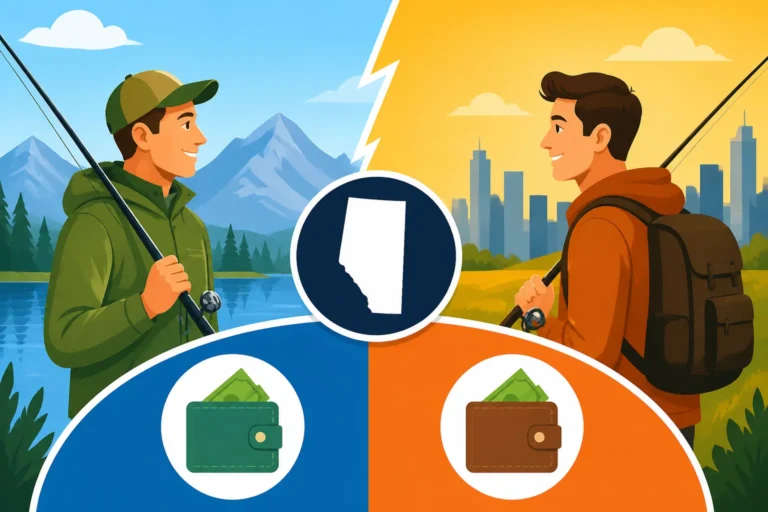
As an out-of-province student, planning your fishing adventures requires a bit more foresight. Non-resident licenses are generally more expensive than resident ones, so budgeting for these costs is important. Knowing the Alberta non-resident Canadian fishing license cost 2026 or the Alberta non-resident non-Canadian fishing license cost 2026 will help you plan your expenses. If you're only going to fish a couple of times a year, the 1-day or 7-day licenses might be more cost-effective. However, if you envision numerous trips, the annual non-resident license often pays for itself.
Here are some tips to maximize your fishing experience:
- Plan Ahead for Shorter Licenses: If you opt for a 1-day or 7-day license, try to consolidate your fishing efforts during that specific period. For instance, if you get a 7-day license, plan a multi-day camping and fishing trip to a scenic area like Kananaskis Country or the areas around the Red Deer River. You can even grab some affordable camping and fishing accessories from Amazon before you head out.
- Explore Local Opportunities: Alberta has an incredible diversity of fishing spots. From the world-renowned trout fishing on the Bow River Fishing Guide right near Calgary, to the numerous stocked ponds in provincial parks ideal for a quick day trip, there's always an accessible option. Provincial parks are often a great choice for students without boats, as many offer easy shore access. For more ideas, consult the Alberta Provincial Park Fishing Guide.
- Understand the Regulations: Beyond just having the correct license, you must also adhere to all provincial fishing regulations. This includes understanding catch limits, size restrictions, bait bans, and specific season dates for different zones and species. The Reading the Alberta Guide to Sportfishing Regulations is an essential read, and you can even download the Alberta Fishing Regulations App and Zone Lookup, Explained to have all the information right on your phone. Many streams, especially in the mountains, have special regulations, like the Alberta barbless hook requirement waters, which you absolutely must respect.
- Gear Up Smart: As a student, you might be on a tighter budget. You don't need the most expensive gear to catch fish. A reliable spinning combo, a selection of basic lures or bait, and a pair of pliers are usually enough to get started. Don't forget essentials like a hat, sunscreen, and maybe even a compact first-aid kit, all of which you can easily find on Amazon.
Here's a quick comparison of general license types you might encounter:
| Feature/Requirement | Alberta Resident | Out-of-Province Canadian Student | Out-of-Province International Student |
|---|---|---|---|
| Residency Definition | Primary domicile in Alberta for 90+ days | Primary domicile outside Alberta | Primary domicile outside Canada |
| Required License | Resident Annual Fishing License | Non-Resident Annual, 7-Day, or 1-Day | Non-Resident Annual, 7-Day, or 1-Day |
| WIN Card | Required | Required | Required |
| Cost | Lowest | Mid-range | Highest (e.g., Alberta non-resident non-Canadian fishing license cost 2026) |
| Proof of Identity | Alberta ID (DL, etc.) | Home Province ID (DL, Passport) | Home Country ID (Passport, Visa) |
| Eligibility | Meets AB residency criteria | Attending school in AB, but not meeting AB residency | Attending school in AB, but not meeting AB residency |
Making sure you have the right license and understand the regulations means you can fully immerse yourself in the natural beauty and thrilling fishing opportunities Alberta has to offer, without any unnecessary stress or legal worries.
Disclaimer
The information provided in this guide is for general informational purposes only and does not constitute legal advice. Fishing regulations in Alberta are subject to change, and it is the responsibility of every angler to consult the most current Alberta Guide to Sportfishing Regulations before engaging in any fishing activity. Always verify specific rules and requirements with official government sources such as MyWildAlberta.com.