Alberta Pleasure Craft License vs Pleasure Craft Operator Card
It’s a tale as old as time on Alberta’s beautiful waterways: you're excited to hit the lake or river, but a nagging thought pops into your head about boating regulations. Specifically, the terms "Pleasure Craft Operator Card" and "Pleasure Craft License" often get mixed up, leading to a frustrating loop of confusion for many anglers and recreational boaters. Rest assured, you're not alone in wondering about the difference, and understanding both is absolutely essential for a legal and safe experience on the water. This guide is designed to thoroughly demystify these two crucial pieces of paperwork, helping you confidently navigate Alberta's boating rules.
Understanding the Pleasure Craft Operator Card PCOC
Let's start with the Pleasure Craft Operator Card, or PCOC. Think of this as your "driver's license" for a boat. It's about you, the person at the helm, proving you have the basic knowledge to operate a boat safely and responsibly. It’s a personal credential, not tied to any specific vessel, and it’s a nationwide requirement in Canada, not just Alberta.
Understanding the PCOC Requirement
The PCOC is proof that you, as an operator, have a fundamental understanding of boating safety, navigation rules, and how to react in various on-water situations. This includes everything from knowing how to handle emergencies like capsizing or engine failure, to understanding buoy markers and respecting other water users. Transport Canada mandates this card for anyone operating a motorized pleasure craft in Canadian waters, regardless of the size of the boat or the horsepower of its engine.
This means if you're planning to take your fishing boat out for walleye on Lesser Slave Lake, or even just a small tinner with an electric trolling motor on a pond near Calgary, you need a PCOC. There's a persistent myth that boats under a certain horsepower or length are exempt, but for motorized pleasure craft, this is generally not the case. The requirement covers almost all scenarios where you're operating a boat with an engine. To really get into the specifics, you can dive deeper into our comprehensive guide on the Alberta Pleasure Craft Operator Card Requirement.
Getting Your PCOC The Process
Obtaining your PCOC is a relatively straightforward process, designed to educate you on safe boating practices. The most common and convenient method is to complete an accredited online boating safety course. These courses are comprehensive, covering topics like Canadian boating regulations, emergency procedures, safety equipment, and environmental awareness. They typically include interactive lessons, quizzes, and culminate in a final exam.
Once you successfully pass the exam, the course provider issues your PCOC. It's a "once-in-a-lifetime" certification – meaning, once you have it, it's valid forever! You don't need to renew it, which is a huge relief for many boaters. However, if you lose your card, you'll need to contact the course provider to get a replacement. Many people wonder about the card's longevity, and we have a detailed article that answers this exact question: Does a Pleasure Craft Operator Card Expire in Alberta?. To help prepare for the course, you might even find study guides or flashcards available on platforms like Amazon, offering a solid foundation before you start.
The Importance of Carrying Your PCOC
While your PCOC might be valid for life, the law requires you to carry proof of competency with you at all times when operating a motorized pleasure craft. This could be your physical PCOC card, or a printout of a temporary card you received immediately after passing your online exam. Forgetting your card at home can lead to fines if you're stopped by enforcement officers from the RCMP or provincial authorities.
Think of it like driving your car: you wouldn't intentionally leave your driver's license behind. The same vigilance applies to your PCOC when boating. This is a critical component of the broader Alberta Boating Laws for Anglers, ensuring that everyone on the water is not only aware of the rules but also accountable for their actions. It's all about promoting a safe and enjoyable environment for everyone sharing Alberta's beautiful lakes and rivers.
The Pleasure Craft License
Now, let's turn our attention to the Pleasure Craft License. If the PCOC is your driver's license, then the Pleasure Craft License is like the license plate for your boat. It’s an identification number issued to the vessel itself, not the operator. This distinction is crucial and often where the confusion begins for many Albertans.
When is a Pleasure Craft License Required?
A Pleasure Craft License is mandatory for most motorized pleasure craft that have a motor of 10 horsepower (7.5 kW) or more. The key exception here is if your boat is already "registered" with Transport Canada. Federal registration (often seen on larger yachts or commercial vessels) is a separate process and comes with its own unique identifier. For the vast majority of recreational fishing boats, ski boats, pontoon boats, and personal watercraft (PWCs) in Alberta, a Pleasure Craft License is required if the engine meets or exceeds the 10 HP threshold.
This license provides a unique identification number for your vessel, which is vital for several reasons. Firstly, it assists law enforcement in identifying boats and ensuring compliance with regulations. More importantly, in an emergency situation, search and rescue services can use this license number to quickly identify your vessel, locate its owner, and determine vital information, potentially saving lives. For a deeper dive into this, check out our article, Alberta Pleasure Craft License, Explained.
How to Obtain a Pleasure Craft License
Unlike the PCOC, which involves a paid course, obtaining a Pleasure Craft License from Transport Canada is completely free. The application process is generally done online or by mail and requires you to provide specific information about your vessel and proof of ownership. You'll need details such as the boat's make, model, hull identification number (HIN), and a photograph of the vessel.
Once your application is approved, Transport Canada will issue you a unique license number. It’s important to note that, unlike the PCOC, a Pleasure Craft License is not permanent. It needs to be renewed every 10 years. Keeping track of this renewal date is crucial to ensure your vessel remains compliant. While the application is free, you might want to pick up some durable decal kits for your boat numbers, which can be easily found on online marketplaces like Amazon, to ensure they meet legal requirements. You can also learn more about keeping your boat's paperwork current in our detailed post about the Alberta boat registration renewal period.
Displaying Your License Numbers
Receiving your Pleasure Craft License number is only half the battle; correctly displaying it on your boat is just as important. The law is very specific: the license number must be clearly visible, painted or permanently affixed to both sides of the bow (the front half) of your pleasure craft. The numbers and letters must be in block characters, at least 7.5 cm (3 inches) high, and in a colour that contrasts sharply with the background.
Imagine being out on Pigeon Lake or Cold Lake and seeing a boat with barely visible or improperly sized numbers; it makes it incredibly difficult for anyone to identify that vessel, especially in an emergency or if it's involved in an incident. This clear display requirement is fundamental to enforcement and safety, playing a key role in the overall Alberta Boat Registration Rules. Without these numbers prominently displayed, even if you have a valid license, you could still face penalties for non-compliance.
Key Differences and Why It Matters
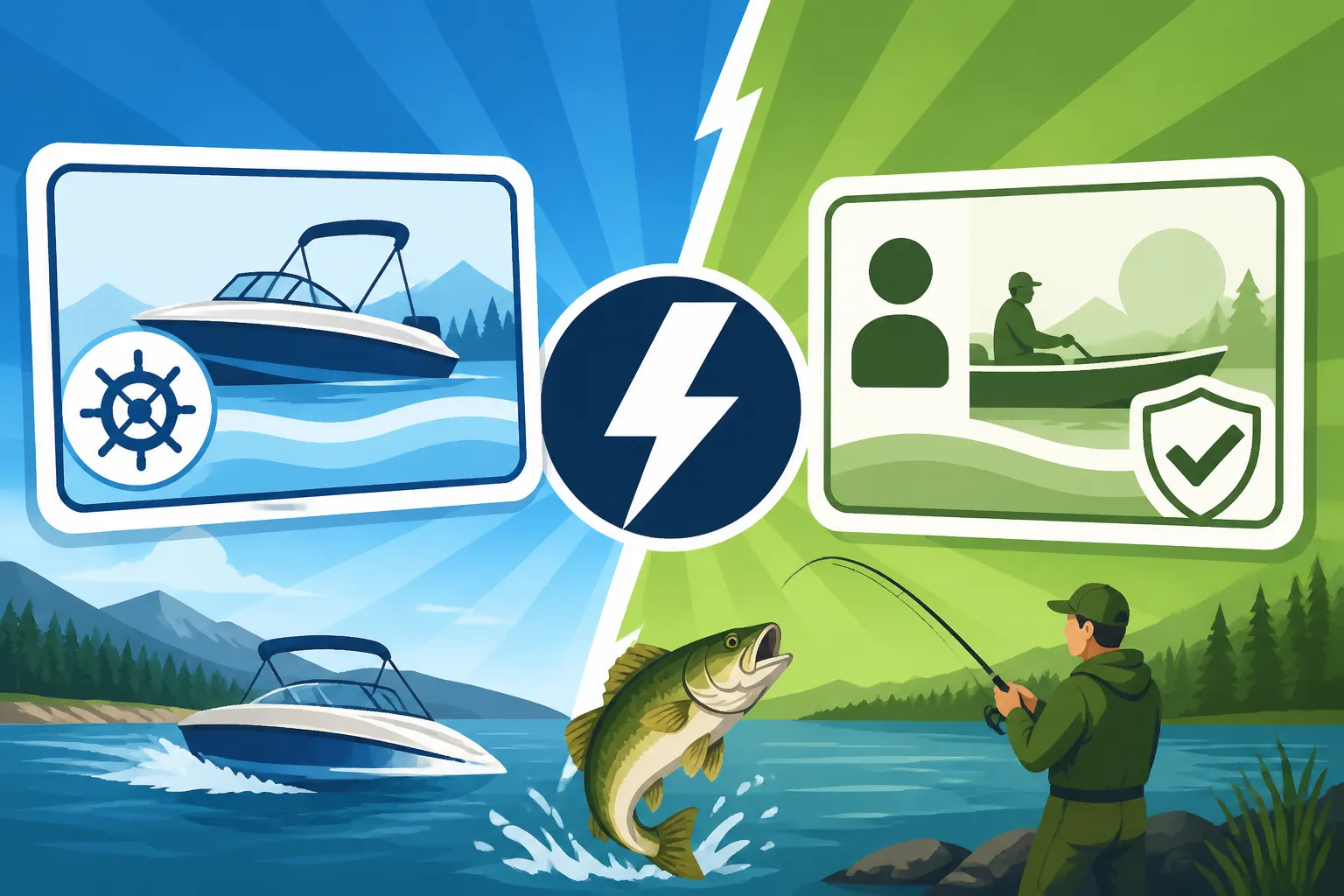
The distinct roles of the PCOC and the Pleasure Craft License are often blurred in conversation, but understanding their separate functions is fundamental to being a responsible boater in Alberta. They serve different purposes, apply to different entities (person vs. vessel), and have different administrative requirements.
A Side-by-Side Comparison
To truly clarify the distinction, let's put them side-by-side:
| Feature | Pleasure Craft Operator Card (PCOC) | Pleasure Craft License |
|---|---|---|
| What it identifies | The individual operating the boat (proof of competency). | The vessel itself (unique identification number). |
| Who needs it | Anyone operating a motorized recreational vessel. | Motorized vessels 10 HP (7.5 kW) or more (unless federally registered). |
| Issued by | Transport Canada accredited course providers (after passing exam). | Transport Canada. |
| Cost | Varies by course provider (typically $30-$60 CAD for the course). | Free. |
| Validity | For life (does not expire). | 10 years (requires renewal). |
| Display Requirement | Must be carried by the operator (physical card or proof). | Numbers must be permanently displayed on the bow of the vessel. |
| Purpose | Ensures operator has basic boating knowledge for safety. | Identifies the boat for safety and enforcement purposes. |
Real-World Scenarios to Clarify
Let's imagine a couple of scenarios common on Alberta's waters to make this distinction crystal clear.
Scenario 1: Sharing the Helm
You're on the Bow River, enjoying a drift fishing trip with your family. You, the boat owner, have your PCOC. Your teenage son, who has just turned 16, wants to try steering the boat for a bit. If he takes the helm of your motorized vessel, he must also possess his own PCOC. Your card doesn't cover him. The PCOC is about individual competency, so every person who operates a motorized pleasure craft needs one. Even if you're sitting right beside him, supervising, he still needs his own card. This is about personal accountability and ensuring everyone operating a boat understands the rules.
Scenario 2: Buying a Used Boat
You've just bought a fantastic used fishing boat for exploring the depths of Lake Athabasca. The previous owner had a Pleasure Craft License for it, and the numbers are still proudly displayed on the bow. While the boat has a license number, that license is still in the previous owner's name. You need to transfer that Pleasure Craft License into your name by applying to Transport Canada. This ensures that the vessel is correctly identified as your property, which is crucial for search and rescue operations or if the boat is ever stolen or involved in an accident. You could have your PCOC, be an expert boater, and have all the safety gear, but if the boat itself isn't properly licensed in your name, you're still not fully compliant.
Consequences of Non-Compliance
Ignoring either of these requirements can lead to more than just a minor inconvenience; it can result in significant fines and legal complications. Operating a motorized pleasure craft without a valid PCOC can incur substantial penalties from Transport Canada, often reaching into the hundreds of dollars. Similarly, operating a vessel that requires a Pleasure Craft License without one, or with one that is improperly displayed or expired, can also lead to hefty fines.
These regulations aren't just bureaucratic red tape; they are fundamental to promoting safety on our waters. A properly trained operator (PCOC) and an identifiable vessel (Pleasure Craft License) are the cornerstones of responsible boating. Beyond the financial penalties, non-compliance could also impact insurance claims in the event of an accident. You can find more details on potential penalties, such as the Alberta maximum fine for no Pleasure Craft Operator Card, by consulting official Transport Canada or provincial resources. It’s always better to be prepared and compliant than to risk a fine or, worse, an unsafe situation.
Ensuring You're Compliant on Alberta Waters
Navigating boating regulations might seem daunting at first, but once you understand the clear distinctions between the Pleasure Craft Operator Card and the Pleasure Craft License, staying compliant becomes much simpler. It's about a few key steps that ensure both you and your vessel are ready for any adventure Alberta's waters throw your way.
Step-by-Step Compliance Checklist
To help you stay on the right side of the law and ensure a safe, worry-free time on the water, here’s a handy checklist:
- Obtain Your PCOC: If you plan to operate any motorized pleasure craft, take an approved boating safety course and get your Pleasure Craft Operator Card. Remember, it's a one-time requirement for life, but keep it accessible when you're boating.
- License Your Boat: For any motorized vessel with a motor of 10 HP or more (and not federally registered), apply for your free Pleasure Craft License from Transport Canada. Ensure the license numbers are correctly and clearly displayed on both sides of your boat's bow. Make a note of the 10-year renewal date!
- Check Essential Safety Equipment: Beyond the PCOC and license, your vessel needs specific safety equipment onboard. This includes life jackets or PFDs for every single person on the boat, a sound-signalling device, bailer or pump, navigation lights (if operating after sunset or in restricted visibility), and more. Our guide on Life Jacket Requirements for Alberta Boaters offers crucial details. You can easily find certified safety kits and individual items, like marine whistles or spare life jackets, through retailers like Amazon to ensure you’re fully equipped.
- Know the Local Rules: Always familiarize yourself with specific regulations for the body of water you intend to visit. Some lakes or rivers might have speed restrictions, specific fishing zone rules, or other unique requirements. The annual Reading the Alberta Guide to Sportfishing Regulations is an invaluable resource that covers not only fishing but also general boating information pertinent to anglers.
Common Misconceptions to Avoid
Despite the clear guidelines, certain misconceptions persist among boaters. Let's clear up some of the most common ones:
- "I have a fishing license, so I can operate a boat." This is a very common mix-up. Your Alberta Fishing License Guide for 2026 allows you to legally fish in Alberta waters; it has absolutely no bearing on your ability to legally operate a motorized boat. These are entirely separate regulations overseen by different authorities for different purposes.
- "My friend has a PCOC, so I'm covered when I drive their boat." False. The PCOC is personal. If you are operating the boat, you need your own PCOC, regardless of whether the owner or another PCOC-holding individual is on board.
- "My boat is a 'fishing boat,' not a 'pleasure craft,' so these rules don't apply." The term "pleasure craft" refers to any vessel used for recreation, sport, or leisure. A fishing boat definitely falls under this category, so the PCOC and Pleasure Craft License rules absolutely apply.
Resources for Boaters
Staying informed and compliant is easier than you might think, thanks to a wealth of resources available. The official Transport Canada website (specifically their Office of Boating Safety section) is your go-to for all federal regulations concerning the PCOC and Pleasure Craft Licensing. They offer detailed guides, FAQs, and links to accredited course providers.
For acquiring essential safety gear and boat accessories, large online retailers remain a convenient option. Whether you need a new marine first-aid kit, an anchor for fishing, or are even researching the Best Boats for Alberta Lakes and Rivers, sites like Amazon can provide a vast selection. Additionally, provincial boating and fishing organizations often publish local guidelines and tips. Consulting our Alberta required boat safety equipment checklist can also help ensure you have everything you need for a safe and legal outing. By actively seeking out and using these resources, you can ensure every trip on Alberta's waters is both enjoyable and fully compliant.
Disclaimer
The information provided in this guide is for general informational purposes only and does not constitute legal advice. While we strive to keep the information up-to-date and accurate, boating regulations can change. Always consult the official Transport Canada website and the Alberta Guide to Sportfishing Regulations for the most current and authoritative information. It is the responsibility of each boater to ensure full compliance with all applicable federal, provincial, and local laws and regulations.